Seismic Qualification (IEEE 693/IBC)
Earthquake resistance verification for critical facilities
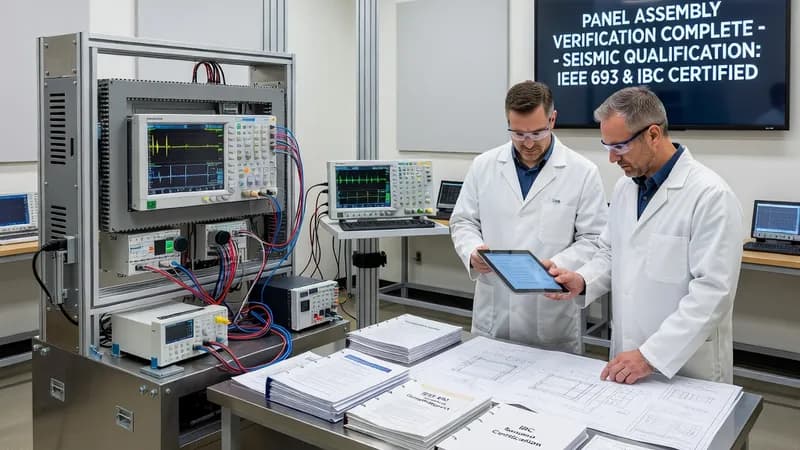
Seismic Qualification for IEC 61439 panel assemblies verifies that low-voltage switchgear and controlgear assemblies can retain structural integrity, electrical continuity, and operational functionality during and after earthquake events. For critical infrastructure, the qualification scope typically includes main distribution boards, power control centers, motor control centers, automatic transfer switches, generator control panels, and custom engineered assemblies installed in hospitals, data centers, utilities, oil-and-gas plants, and transportation facilities. In practice, seismic performance is assessed alongside the IEC 61439 design verification framework, including temperature rise, short-circuit withstand strength, dielectric properties, clearances and creepage distances, mechanical operation, and protective circuit continuity. The seismic qualification itself is commonly demonstrated using IEEE 693 for substation and utility environments or via IBC and ASCE 7 load criteria for building-mounted equipment. For certain hazardous or special locations, related considerations may also interact with IEC 60079 requirements, while arc-flash containment and internal fault resilience may be validated separately under IEC/TR 61641 for LV switchboards. Qualification methods depend on the installation context and project risk profile. Shake-table testing is the most direct method for proving equipment survivability under representative ground motion, with performance levels often defined by horizontal acceleration, vertical acceleration, and post-test operability. Static or equivalent lateral force analysis may be used for anchored assemblies when permitted by the project’s structural engineer, including evaluation of anchor bolts, base frames, center of gravity, and floor slab interaction. For complex systems with busbar trunking, VFDs, soft starters, protection relays, and ACBs or MCCBs, engineers must also verify that internal supports, wiring looms, terminals, and auxiliary devices remain secure under multi-axis excitation. In IEC 61439 assemblies, the design must preserve form of separation, compartment integrity, and functional isolation after seismic loading, especially in Form 2, Form 3, or Form 4 constructions where partition and barrier performance matters. Real-world seismic design goes beyond the enclosure shell. Busbars need flexible joints or expansion links where building movement is expected, cable entries must allow strain relief, and heavy devices such as draw-out air circuit breakers, power meters, and protection relays should be mounted with anti-vibration hardware and positive retention features. Rated currents in qualified assemblies commonly range from 160 A in control panels to 6300 A in main switchboards, with short-circuit ratings verified up to the project-specific fault level, often 50 kA, 65 kA, or higher depending on upstream network conditions. Compliance documentation should clearly identify the tested configuration, anchoring method, mounting orientation, mass distribution, and any restrictions on field modifications. For EPC contractors and facility owners, seismic qualification is essential for ensuring continuity of service, safe shutdown capability, and rapid recovery after an earthquake, particularly in mission-critical facilities where loss of power distribution can cause unacceptable downtime or safety risk.
Panels Certified to This Standard
Primary power distribution from transformer to sub-circuits. Rated up to 6300A. Houses main incoming breaker, bus-section, and outgoing feeders.
High-capacity power distribution for industrial facilities. Controls and distributes incoming power to MCC, APFC, and downstream loads.
Centralized motor control with starters, contactors, overloads, and VFDs in standardized withdrawable/fixed functional units.
Automatic changeover between mains and generator/UPS. Open or closed transition, with or without bypass.
Genset start/stop sequencing, synchronization, load sharing, and paralleling controls.
Prefabricated busbar distribution per IEC 61439-6. Sandwich or air-insulated, aluminum or copper.
Bespoke panel assemblies for non-standard requirements — special ratings, unusual form factors, multi-function combinations.
Related Industries
High-reliability MDB, PCC, ATS (STS), metering, APFC, BTS, DC distribution
ATS (critical power), MDB, generator control, lighting, metering, APFC
MDB, ATS, metering, BTS, lighting distribution, DC distribution
Ex-rated panels, MCC, PCC, VFD, generator control, soft starters, ATEX/IECEx compliance
Related Knowledge Articles
Frequently Asked Questions
Ready to Engineer Your Next Panel?
Our team of electrical engineers is ready to design, build, and deliver your custom panel solution — fully compliant with international standards.