Contactors & Motor Starters in Motor Control Center (MCC)
Contactors & Motor Starters selection, integration, and best practices for Motor Control Center (MCC) assemblies compliant with IEC 61439.
Overview
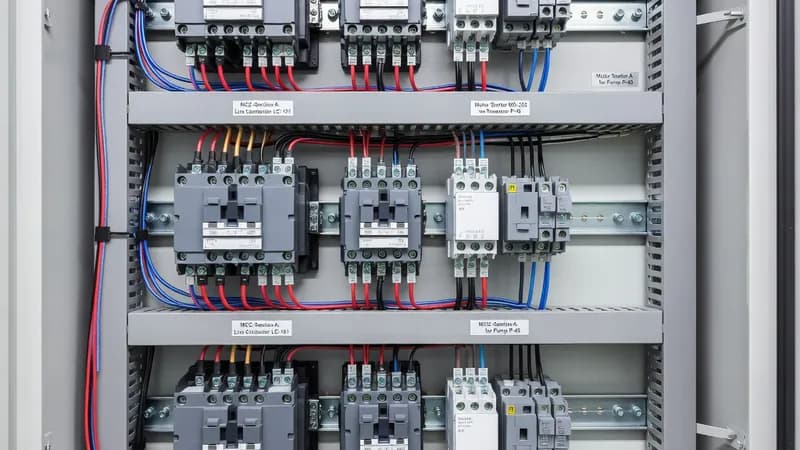
Contactors and motor starters are among the most critical functional units in a Motor Control Center (MCC), because they directly determine starting performance, thermal loading, operational continuity, and maintainability of each motor feeder. In an IEC 61439 MCC assembly, these components must be selected and verified as part of the complete panel system, not as isolated devices. That means the contactor duty class, overload relay setting range, feeder protection device, busbar rating, compartment arrangement, and ventilation strategy all have to be coordinated to achieve the declared assembly performance. For industrial MCCs, busbar systems are commonly engineered from 630 A up to 6300 A, while individual motor feeders may range from fractional-kilowatt pumps to large process motors of several hundred kilowatts depending on starting method and service factor. For standard direct-on-line feeders, AC-3 contactors to IEC 60947-4-1 are typically used, selected by motor full-load current, ambient temperature, altitude, and the number of starts per hour. For more demanding duty, AC-4-rated switching, reversing starters, or inching/jogging applications require careful assessment of electrical endurance and thermal stress. Motor starters may be implemented with thermal overload relays, electronic motor protection relays, or motor protection circuit breakers (MPCBs), depending on the required protection philosophy. In modern MCCs, soft starters and variable frequency drives (VFDs) are often integrated as dedicated functional units to reduce inrush current, improve process control, and limit mechanical stress on pumps, compressors, conveyors, and fans. These devices must be coordinated with upstream ACBs or MCCBs, and with downstream motor insulation levels, cable sizing, and harmonic effects when VFDs are applied. Type of coordination is a key selection criterion. In many industrial plants, Type 2 coordination is preferred under IEC 60947-4-1 because it permits continued operation after a short-circuit event without unacceptable damage to the starter components. The assembly short-circuit withstand rating, declared in accordance with IEC 61439-1 and IEC 61439-2, must cover the prospective fault current at the installation point, including the contribution from the incoming transformer and any generator source. Where the MCC serves critical infrastructure, selective coordination with upstream protection devices may be required to isolate only the affected feeder. For communication-ready installations, intelligent relays and drive controllers can exchange data via Modbus TCP, Profinet, Profibus, EtherNet/IP, or similar industrial protocols for SCADA and BMS monitoring. Thermal design is equally important. Contactors, overload relays, soft starters, VFD heat sinks, and control transformers all add internal losses that can raise compartment temperature beyond manufacturer limits if spacing and ventilation are insufficient. IEC 61439 temperature-rise verification is therefore essential, especially in compact fixed-form MCC sections or high-density withdrawable buckets. Internal separation may be specified as Form 2, Form 3b, or Form 4 to improve maintenance safety, limit fault propagation, and support staged expansion. Cable routing, gland plates, neutral and PE bars, and auxiliary wiring must be arranged to preserve creepage distances and maintain electromagnetic compatibility. For dusty, humid, or harsh industrial environments, enclosure selection and sealing must be matched to the application, while special considerations may apply under IEC 60079 for hazardous areas and IEC 61641 where arc fault containment is required. Patrion designs and manufactures MCC assemblies in Turkey for EPC contractors, OEMs, and industrial plant operators, providing coordinated selection of contactors, starters, motor protection devices, busbars, and enclosure systems for reliable, standards-compliant motor control applications.
Key Features
- Contactors & Motor Starters rated for Motor Control Center (MCC) operating conditions
- IEC 61439 compliant integration and coordination
- Thermal management within panel enclosure limits
- Communication-ready for SCADA/BMS integration
- Coordination with upstream and downstream protection devices
Specifications
| Property | Value |
|---|---|
| Panel Type | Motor Control Center (MCC) |
| Component | Contactors & Motor Starters |
| Standard | IEC 61439-2 |
| Integration | Type-tested coordination |
Other Components for Motor Control Center (MCC)
Branch protection 16A–1600A, thermal-magnetic or electronic trip
Motor speed control, energy savings, 0.37kW–500kW+
Reduced voltage motor starting, torque control, bypass options
Overcurrent, earth fault, differential, generator protection relays
Copper/aluminum busbars, busbar supports, tap-off units
Programmable logic controllers, remote I/O, fieldbus communication
Other Panels Using Contactors & Motor Starters
Automatic capacitor switching for reactive power compensation. Thyristor or contactor-switched, detuned or standard configurations.
Automatic changeover between mains and generator/UPS. Open or closed transition, with or without bypass.
Enclosed VFD assemblies with input protection, line reactors, EMC filters, output reactors, and bypass options.
Process and machine control panels housing PLCs, I/O modules, relays, HMIs, and communication infrastructure.
Bespoke panel assemblies for non-standard requirements — special ratings, unusual form factors, multi-function combinations.
Enclosed soft starter assemblies for reduced voltage motor starting with torque control, ramp-up/down profiles, and bypass contactor options.
Active or passive harmonic filtering to mitigate THD from non-linear loads. Tuned LC filters, active filters, or hybrid configurations.
Fixed or automatic capacitor bank assemblies for bulk reactive power compensation in industrial and utility applications.
Frequently Asked Questions
Ready to Engineer Your Next Panel?
Our team of electrical engineers is ready to design, build, and deliver your custom panel solution — fully compliant with international standards.