Busbar Systems in Motor Control Center (MCC)
Busbar Systems selection, integration, and best practices for Motor Control Center (MCC) assemblies compliant with IEC 61439.
Overview
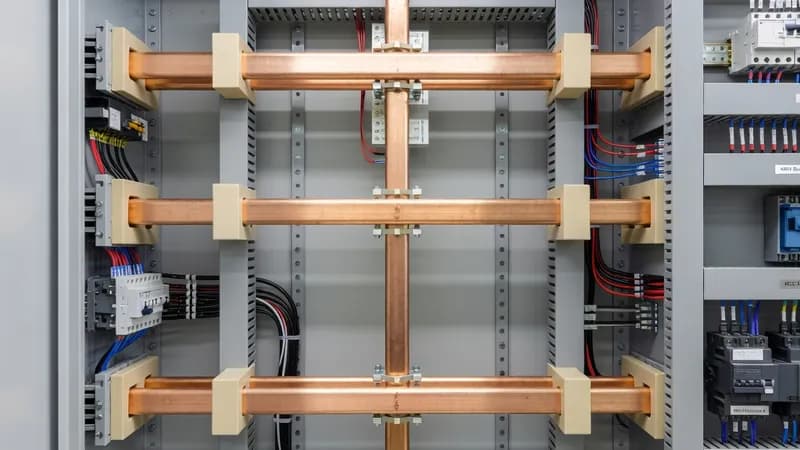
Busbar systems are the backbone of a Motor Control Center (MCC), distributing incoming power reliably to fixed, withdrawable, or plug-in motor feeders while maintaining thermal and short-circuit integrity under IEC 61439-1 and IEC 61439-2. In modern MCC assemblies, the busbar package typically includes phase and neutral bars in copper or aluminum, protective earth bars, insulated supports, shrouds, cross-bracing, and feeder tap-off interfaces. Selection is driven by rated operational current, diversity factor, permissible temperature rise, and the declared short-circuit withstand values of the complete assembly, not just the individual bar material. Typical MCC busbar ratings range from 400 A for compact lineups to 6300 A for large process plants, with short-circuit ratings commonly verified at 50 kA, 65 kA, 80 kA, or higher depending on the design verification dossier. For MCC applications, busbar arrangement must coordinate with incoming ACBs, feeder MCCBs, motor starters, VFDs, soft starters, and protection relays. The busbar system must support the upstream fault-clearing capability of the main circuit breaker and remain thermally stable when multiple motor feeders start simultaneously or when VFD harmonics increase losses. Proper sizing considers enclosure derating, ambient temperature, ventilation strategy, and internal separation forms. IEC 61439-2 requires design verification for temperature-rise limits, dielectric properties, short-circuit strength, and clearances/creepage distances. In practical MCC constructions, Form 2, Form 3, or Form 4 separation is selected to improve maintainability and limit fault propagation between functional units, with Form 4b often preferred in critical process plants and water treatment facilities. Busbar supports and insulators must be selected for mechanical endurance and flame resistance, with spacing optimized to withstand electrodynamic forces during faults. For industrial environments, the busbar system may be enclosed in a dedicated busbar chamber separated from functional units, with touch-safe barriers and finger-protected access to reduce arc-flash exposure during maintenance. Where corrosive or dusty atmospheres exist, tinned copper, aluminum with surface treatment, or fully shrouded systems are commonly specified. In hazardous areas, the MCC enclosure may need additional conformity considerations under IEC 60079, while arc containment features and internal segregation should be evaluated alongside IEC TR 61641 guidance for arc fault testing. Communication-ready MCCs increasingly integrate busbar monitoring, smart metering, and gateway devices for SCADA/BMS connectivity. Although the busbars themselves do not communicate, the busbar system must accommodate current transformers, power meters, protection relays, and networked motor management devices without compromising creepage, heat dissipation, or maintenance access. This is especially important in industry sectors such as oil and gas, mining, cement, food processing, desalination, and district utilities, where continuous operation and selective coordination are mandatory. A properly engineered busbar system in an MCC is therefore not only a conductor path but a verified power-distribution architecture that balances ampacity, fault endurance, modularity, and lifecycle maintainability in accordance with IEC 61439 requirements.
Key Features
- Busbar Systems rated for Motor Control Center (MCC) operating conditions
- IEC 61439 compliant integration and coordination
- Thermal management within panel enclosure limits
- Communication-ready for SCADA/BMS integration
- Coordination with upstream and downstream protection devices
Specifications
| Property | Value |
|---|---|
| Panel Type | Motor Control Center (MCC) |
| Component | Busbar Systems |
| Standard | IEC 61439-2 |
| Integration | Type-tested coordination |
Other Components for Motor Control Center (MCC)
Branch protection 16A–1600A, thermal-magnetic or electronic trip
Motor speed control, energy savings, 0.37kW–500kW+
Reduced voltage motor starting, torque control, bypass options
DOL/star-delta/reversing starters, overload relays, Type 2 coordination
Overcurrent, earth fault, differential, generator protection relays
Programmable logic controllers, remote I/O, fieldbus communication
Other Panels Using Busbar Systems
Primary power distribution from transformer to sub-circuits. Rated up to 6300A. Houses main incoming breaker, bus-section, and outgoing feeders.
High-capacity power distribution for industrial facilities. Controls and distributes incoming power to MCC, APFC, and downstream loads.
Enclosed VFD assemblies with input protection, line reactors, EMC filters, output reactors, and bypass options.
Energy metering, power quality analysis, and multi-circuit monitoring with communication gateways.
Final distribution for lighting and small power. MCB/RCBO-based with DALI or KNX integration options.
Prefabricated busbar distribution per IEC 61439-6. Sandwich or air-insulated, aluminum or copper.
Bespoke panel assemblies for non-standard requirements — special ratings, unusual form factors, multi-function combinations.
Enclosed soft starter assemblies for reduced voltage motor starting with torque control, ramp-up/down profiles, and bypass contactor options.
DC power distribution for battery systems, solar installations, telecom, and UPS applications. MCCB/fuse-based DC protection.
Fixed or automatic capacitor bank assemblies for bulk reactive power compensation in industrial and utility applications.
Frequently Asked Questions
Ready to Engineer Your Next Panel?
Our team of electrical engineers is ready to design, build, and deliver your custom panel solution — fully compliant with international standards.