Soft Starters in Motor Control Center (MCC)
Soft Starters selection, integration, and best practices for Motor Control Center (MCC) assemblies compliant with IEC 61439.
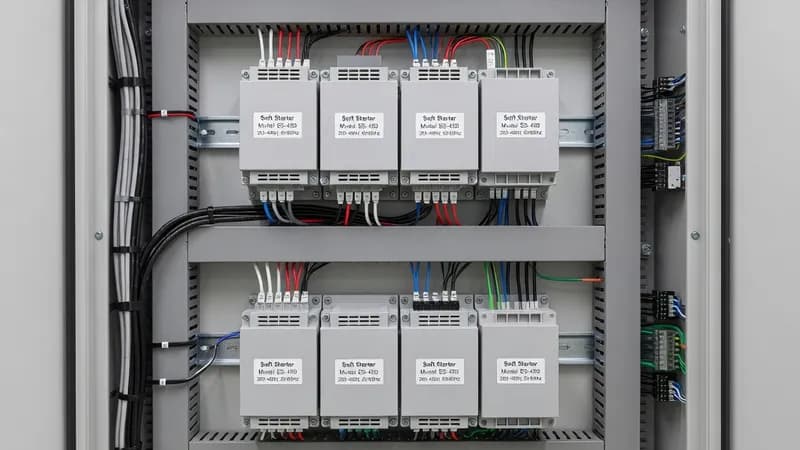
Overview
Soft starters in Motor Control Center (MCC) assemblies are used to limit inrush current, reduce mechanical stress on the driven load, and improve process continuity during motor starting. In IEC 61439-2 low-voltage switchgear and controlgear assemblies, the soft starter must be selected not only for motor duty, but also for its contribution to assembly temperature rise, short-circuit coordination, and functional segregation within the MCC lineup. Typical applications include pumps, fans, compressors, conveyors, crushers, mixers, and HVAC systems where controlled acceleration and deceleration are preferred over direct-on-line starting. In an MCC, a soft starter is commonly paired with a line isolator or MCCB, semiconductor or thermal overload protection as applicable, and a bypass contactor for reduced losses during run mode. The upstream protective device may be an MCCB, fuse switch disconnector, or ACB, sized in accordance with IEC 60947-2 and IEC 60947-4-1 coordination requirements. Downstream motor protection should consider motor full-load current, starting duty, acceleration time, number of starts per hour, and the load torque curve. For larger motors, selection may extend to 200 A, 320 A, 630 A, or higher current classes, while the MCC busbar system must be verified for the total diversity of all feeders and the prospective short-circuit current, often 25 kA, 36 kA, 50 kA, 65 kA, or higher depending on site fault level. Thermal management is critical because soft starters dissipate heat during ramp-up and, if bypass is not used, during continuous operation. The assembly must be evaluated for internal temperature rise, ventilation strategy, derating due to altitude or ambient temperature, and the heat contribution of neighboring devices such as VFDs, protection relays, and PLC I/O modules. IEC 61439-1 and IEC 61439-2 require verification of temperature-rise limits, dielectric properties, clearances, creepage distances, and short-circuit withstand. For industrial MCCs, form of separation often ranges from Form 2b to Form 4b, depending on required maintainability and fault containment between functional units. Soft starters integrated in intelligent MCC panels are frequently equipped with Modbus RTU, Modbus TCP, Profibus, Profinet, EtherNet/IP, or Ethernet-based gateway modules for SCADA and BMS monitoring. Common data points include start/stop status, current, voltage, power, fault history, phase loss, overload, thyristor bypass status, and number of starts. In process facilities, this enables predictive maintenance and better coordination with upstream relays and downstream motor loads. Where the MCC is installed in hazardous areas or adjacent to classified zones, equipment selection should also consider IEC 60079 requirements for explosion-protection interfaces, and where arc-flash mitigation is a concern, assembly design may be validated against IEC 61641 for internal arc effects. Practical configuration in an MCC typically includes draw-out or fixed feeders, branch circuit grouping by process area, a terminal compartment for field wiring, and clearly defined separation between control, power, and communication circuits. For motors with high inertia loads, the soft starter must support adjustable current limit, kick-start, ramp profiles, and soft stop. For fans and pumps, reducing hydraulic shock and belt stress is a key benefit. In engineered MCC panels from Patrion, soft starters are integrated with IEC 61439-2 verified busbar systems, coordinated protection devices, and thermally managed enclosures to deliver reliable motor control in compact, maintainable, and standards-compliant assemblies.
Key Features
- Soft Starters rated for Motor Control Center (MCC) operating conditions
- IEC 61439 compliant integration and coordination
- Thermal management within panel enclosure limits
- Communication-ready for SCADA/BMS integration
- Coordination with upstream and downstream protection devices
Specifications
| Property | Value |
|---|---|
| Panel Type | Motor Control Center (MCC) |
| Component | Soft Starters |
| Standard | IEC 61439-2 |
| Integration | Type-tested coordination |
Other Components for Motor Control Center (MCC)
Branch protection 16A–1600A, thermal-magnetic or electronic trip
Motor speed control, energy savings, 0.37kW–500kW+
DOL/star-delta/reversing starters, overload relays, Type 2 coordination
Overcurrent, earth fault, differential, generator protection relays
Copper/aluminum busbars, busbar supports, tap-off units
Programmable logic controllers, remote I/O, fieldbus communication
Other Panels Using Soft Starters
Bespoke panel assemblies for non-standard requirements — special ratings, unusual form factors, multi-function combinations.
Enclosed soft starter assemblies for reduced voltage motor starting with torque control, ramp-up/down profiles, and bypass contactor options.
Frequently Asked Questions
Ready to Engineer Your Next Panel?
Our team of electrical engineers is ready to design, build, and deliver your custom panel solution — fully compliant with international standards.