MCC Panels

Variable Frequency Drives (VFD) in Motor Control Center (MCC)

Variable Frequency Drives (VFD) selection, integration, and best practices for Motor Control Center (MCC) assemblies compliant with IEC 61439.
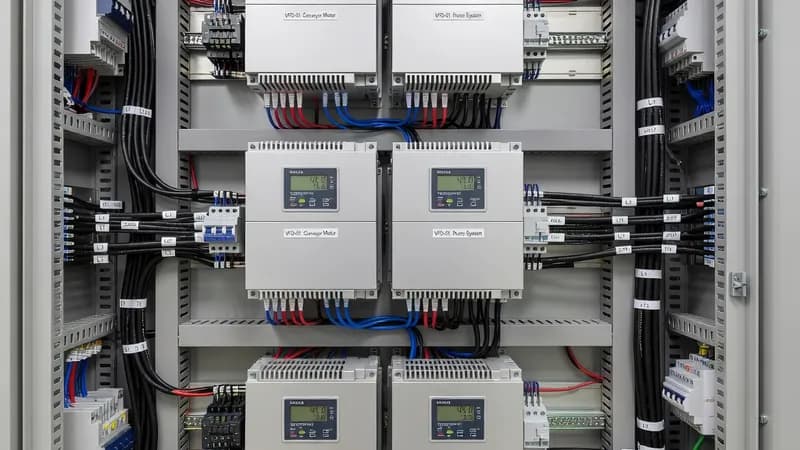
Variable Frequency Drives (VFD) in Motor Control Center (MCC)

Overview

Variable Frequency Drives (VFDs) in Motor Control Center (MCC) assemblies are used to control induction motors, optimize process throughput, and reduce inrush stress on the power distribution system. In IEC 61439-compliant MCCs, VFD selection must be based not only on motor kW and full-load current, but also on enclosure thermal performance, harmonic emission, overload duty, short-circuit coordination, and the panel’s declared assembly rating. Typical applications include pumps, fans, compressors, conveyors, mixers, cooling towers, and HVAC plant rooms where variable torque and energy-saving operation justify speed control over direct-on-line starting. For MCC applications, VFDs are commonly integrated as feeder units or functional modules alongside ACB incomers, MCCB feeders, bus couplers, and control compartments. The drive section may include a line isolator, MCCB or fuse-switch disconnector, EMC line filter, input reactor, output reactor, dv/dt filter, braking chopper, and motor protection relay depending on cable length, motor insulation level, and switching frequency. In process plants, VFDs are often paired with bypass contactors and overload relays for essential-duty motors, allowing continued operation at fixed speed if the drive is unavailable. For intelligent panels, communication via Modbus RTU, Modbus TCP, Profibus, Profinet, Ethernet/IP, or BACnet is frequently required for SCADA and BMS integration. IEC 61439-1 and IEC 61439-2 govern the assembly design, temperature-rise limits, dielectric properties, clearance and creepage distances, and short-circuit withstand of the MCC. For outgoing drive feeders, the panel builder must verify rated current InA, diversity, simultaneous loading, and internal separation form, such as Form 2b, Form 3b, or Form 4 where maintenance segregation is required. The drive’s own rating must be coordinated with the assembly’s busbar system, typically 400/415 V or 690 V, with busbar currents ranging from 630 A to several thousand amperes and prospective short-circuit levels commonly 25 kA, 36 kA, 50 kA, or higher depending on the installation. Coordination with upstream protective devices should follow IEC 60947-2 for MCCBs and ACBs, and with switching devices under IEC 60947-4-1 for contactors and motor starters. Thermal management is a critical design factor because VFD losses are dissipated inside the MCC enclosure. Forced ventilation, top-mounted exhaust, air-conditioning, segregated dirty/clean air paths, or rear heat ducts may be necessary, especially where multiple drives operate at elevated ambient temperatures up to 40 °C or 50 °C derating conditions. Selection must also consider pollution degree, altitude, IP rating, and whether the panel is installed in indoor industrial, utility, or harsh environments. Where drives are installed in potentially explosive atmospheres, the overall system may need alignment with IEC 60079 requirements. In arc-risk industrial installations, IEC 61641 considerations may be relevant for internal arc fault containment. A well-engineered MCC with VFDs provides compact motor control, reduced mechanical stress, lower energy consumption, and easier diagnostics. Patrion designs and manufactures MCC panel assemblies in Turkey for OEMs, EPC contractors, and industrial facilities, delivering application-specific VFD compartments, coordinated protection, and documented IEC verification for modern power distribution systems.

Key Features

  • Variable Frequency Drives (VFD) rated for Motor Control Center (MCC) operating conditions
  • IEC 61439 compliant integration and coordination
  • Thermal management within panel enclosure limits
  • Communication-ready for SCADA/BMS integration
  • Coordination with upstream and downstream protection devices

Specifications

PropertyValue
Panel TypeMotor Control Center (MCC)
ComponentVariable Frequency Drives (VFD)
StandardIEC 61439-2
IntegrationType-tested coordination

Other Components for Motor Control Center (MCC)

Other Panels Using Variable Frequency Drives (VFD)

Frequently Asked Questions

Select the drive based on motor rated current, duty class, overload requirement, ambient temperature, altitude, and the MCC enclosure’s thermal capacity. For IEC 61439 assemblies, the drive’s continuous current must be coordinated with the panel busbar rating and temperature-rise verification. In practice, a 30 kW motor may require a drive rated above nominal current if the load is constant torque, has high starting inertia, or requires 150% overload for 60 seconds. Also check whether the application needs input reactors, EMC filters, or output filters due to cable length or motor insulation stress. A properly engineered MCC should document these items in the assembly design and verification package.
Yes. VFD sections are commonly combined in the same MCC with ACB incomers, bus couplers, and MCCB feeder units, provided the assembly meets IEC 61439-1/2 requirements for segregation, thermal performance, and short-circuit withstand. The incoming ACB typically protects the busbar system, while each drive feeder is coordinated with an MCCB, fuse-switch, or isolating device in accordance with IEC 60947-2 and IEC 60947-3. The key design issue is heat: VFD losses can raise internal cabinet temperature, so the panel layout, ventilation path, and compartment separation must be validated during design verification.
The required short-circuit rating depends on the available fault current at the installation point. MCC assemblies are commonly specified at 25 kA, 36 kA, 50 kA, or higher, and the verified withstand level must cover the busbars, protective devices, terminals, and internal wiring. The VFD itself is rarely the sole limiting factor; the full feeder circuit must be coordinated with upstream protection and, where applicable, semiconductor fuses or current-limiting devices recommended by the drive manufacturer. IEC 61439 requires the assembly manufacturer to verify short-circuit withstand by test, comparison with a verified design, or calculation where permitted.
Often yes, especially when multiple drives are installed on the same bus or when the supply system is sensitive to voltage distortion. A line reactor can reduce input current peaks and improve drive robustness, while an EMC filter helps meet electromagnetic compatibility requirements. For long motor cables, output reactors or dv/dt filters may be needed to reduce reflected-wave overvoltage and motor insulation stress. In plant-wide MCCs, harmonic mitigation should be reviewed early because VFDs can affect transformers, neutral conductors, protection relays, and other equipment. The final selection depends on the utility limits, the number of drives, and the drive topology.
The appropriate form of internal separation depends on maintenance philosophy, uptime requirements, and space constraints. Form 2b is often used for basic segregation of busbars from functional units, while Form 3b or Form 4 is preferred where maintenance isolation of one drive feeder must not affect adjacent feeders. In VFD-rich MCCs, stronger segregation can help control heat and improve serviceability, but it increases panel size and cable routing complexity. IEC 61439 does not mandate a single form; the chosen arrangement must be designed, verified, and documented by the assembly manufacturer for the intended operating conditions.
Coordination usually combines the VFD’s electronic protection functions with upstream overcurrent protection and, where required, motor thermistor or PTC input monitoring. Many applications also use an MCCB or fuse-switch disconnector ahead of the drive to provide short-circuit protection and isolation. For critical motors, a bypass arrangement with contactor and overload relay can be added so the motor can run at line frequency if the drive fails. Coordination should follow the drive manufacturer’s installation instructions and IEC 60947 device ratings to ensure selectivity, fault clearing, and safe maintenance.
Yes. Modern VFD MCCs are typically communication-ready and can expose speed reference, current, fault status, energy data, and run permissives to SCADA or BMS platforms. Common protocols include Modbus RTU, Modbus TCP, Profibus, Profinet, BACnet, and Ethernet/IP. For large facilities, this enables remote diagnostics, alarm trending, and predictive maintenance. When specifying the MCC, define the protocol, gateway requirements, network segregation, and address mapping early so the panel builder can allocate space for communication modules, Ethernet switches, and cabling segregation in accordance with good panel engineering practice.
VFD performance is strongly affected by ambient temperature, altitude, humidity, pollution degree, and enclosure IP rating. Most drives are rated for 40 °C ambient, but derating may be required at higher temperatures or at elevations above 1000 m. Because VFDs dissipate heat inside the MCC, enclosure ventilation, spacing, and compartment layout must be assessed carefully. In some cases, air conditioning, heat exchangers, or forced exhaust is necessary to maintain the assembly within IEC 61439 temperature-rise limits. If the MCC is installed in a hazardous area or exposed to high dust or moisture, additional compliance with IEC 60079 or enhanced enclosure protection may be required.

Ready to Engineer Your Next Panel?

Our team of electrical engineers is ready to design, build, and deliver your custom panel solution — fully compliant with international standards.