Moulded Case Circuit Breakers (MCCB) in Motor Control Center (MCC)
Moulded Case Circuit Breakers (MCCB) selection, integration, and best practices for Motor Control Center (MCC) assemblies compliant with IEC 61439.
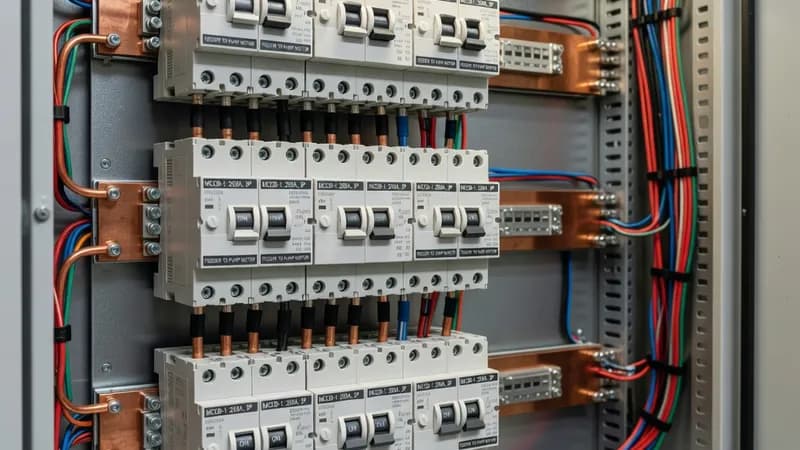
Overview
Moulded Case Circuit Breakers (MCCB) are a core branch-protection device in Motor Control Center (MCC) assemblies, typically used for feeder, transformer, capacitor bank, and large motor outgoing circuits where higher breaking capacity and adjustable protection are required. In IEC 61439-2 assemblies, MCCBs are selected not only for their rated current range, commonly from 16 A up to 1600 A, but also for their utilization category, trip-unit technology, and verified coordination with the MCC busbar system. In practice, MCCB incomers and feeders are specified with thermal-magnetic or electronic trip units, with electronic releases preferred where accurate long-time, short-time, instantaneous, and earth-fault protection settings are needed for discrimination and energy selectivity. For MCC applications, the key technical parameters include rated operational voltage, rated insulation voltage, ultimate short-circuit breaking capacity (Icu), service short-circuit breaking capacity (Ics), and short-time withstand capability when the MCCB is used in a coordinated assembly. The panel builder must confirm that the breaker’s prospective short-circuit performance matches the verified assembly short-circuit rating of the MCC, including the busbar system, functional units, internal conductors, and enclosure. Forms of separation under IEC 61439-2 are also important; MCCBs in withdrawable or fixed feeder modules may be arranged with Forms 1 to 4 segregation, depending on continuity-of-service and maintenance requirements. Thermal performance is a major consideration because MCCs often contain dense vertical busbar sections, VFDs, soft starters, protection relays, control transformers, PLC I/O, and communication gateways. MCCBs contribute heat through current-carrying parts and trip electronics, so derating may be necessary when ambient temperature, altitude, or enclosure ventilation limits are exceeded. Proper spacing, phase barriers, cable routing, and enclosure heat dissipation must be assessed to keep temperature rise within IEC 61439 limits. For modern digital MCCs, MCCBs with Modbus, Profibus, or Ethernet-based communication modules support SCADA/BMS monitoring, breaker status, trip diagnostics, energy metering, and remote operation, improving maintenance planning and asset visibility. In motor feeder applications, MCCBs are often coordinated with contactors and overload relays in combination starters, or they may protect standalone DOL, star-delta, soft starter, or VFD-fed circuits. Coordination with upstream ACBs and downstream disconnecting means should be verified using selectivity tables or tested coordination data from the manufacturer. For industrial facilities, utilities, water treatment plants, oil and gas plants, and commercial infrastructure, MCCB-equipped MCCs provide compact, maintainable, and scalable power distribution. Where hazardous-area adjacent spaces or dust environments are involved, the complete panel solution may also need consideration against IEC 60079 for explosive atmospheres and IEC 61641 for internal arcing resilience, especially in high-availability installations. Patrion MCC panel solutions are engineered in Turkey for real-world industrial duty, with MCCB-based functional units configured to IEC 61439-1/2 requirements, verified short-circuit withstand, documented temperature-rise performance, and practical field maintainability. Whether the application requires fixed or draw-out MCC modules, selective coordination, remote supervision, or space-efficient feeder integration, the MCCB remains one of the most versatile and widely used protection devices in modern low-voltage motor control centers.
Key Features
- Moulded Case Circuit Breakers (MCCB) rated for Motor Control Center (MCC) operating conditions
- IEC 61439 compliant integration and coordination
- Thermal management within panel enclosure limits
- Communication-ready for SCADA/BMS integration
- Coordination with upstream and downstream protection devices
Specifications
| Property | Value |
|---|---|
| Panel Type | Motor Control Center (MCC) |
| Component | Moulded Case Circuit Breakers (MCCB) |
| Standard | IEC 61439-2 |
| Integration | Type-tested coordination |
Other Components for Motor Control Center (MCC)
Motor speed control, energy savings, 0.37kW–500kW+
Reduced voltage motor starting, torque control, bypass options
DOL/star-delta/reversing starters, overload relays, Type 2 coordination
Overcurrent, earth fault, differential, generator protection relays
Copper/aluminum busbars, busbar supports, tap-off units
Programmable logic controllers, remote I/O, fieldbus communication
Other Panels Using Moulded Case Circuit Breakers (MCCB)
Primary power distribution from transformer to sub-circuits. Rated up to 6300A. Houses main incoming breaker, bus-section, and outgoing feeders.
High-capacity power distribution for industrial facilities. Controls and distributes incoming power to MCC, APFC, and downstream loads.
Automatic capacitor switching for reactive power compensation. Thyristor or contactor-switched, detuned or standard configurations.
Automatic changeover between mains and generator/UPS. Open or closed transition, with or without bypass.
Enclosed VFD assemblies with input protection, line reactors, EMC filters, output reactors, and bypass options.
Genset start/stop sequencing, synchronization, load sharing, and paralleling controls.
Energy metering, power quality analysis, and multi-circuit monitoring with communication gateways.
Final distribution for lighting and small power. MCB/RCBO-based with DALI or KNX integration options.
Prefabricated busbar distribution per IEC 61439-6. Sandwich or air-insulated, aluminum or copper.
Process and machine control panels housing PLCs, I/O modules, relays, HMIs, and communication infrastructure.
Bespoke panel assemblies for non-standard requirements — special ratings, unusual form factors, multi-function combinations.
Enclosed soft starter assemblies for reduced voltage motor starting with torque control, ramp-up/down profiles, and bypass contactor options.
Active or passive harmonic filtering to mitigate THD from non-linear loads. Tuned LC filters, active filters, or hybrid configurations.
DC power distribution for battery systems, solar installations, telecom, and UPS applications. MCCB/fuse-based DC protection.
Fixed or automatic capacitor bank assemblies for bulk reactive power compensation in industrial and utility applications.
Frequently Asked Questions
Ready to Engineer Your Next Panel?
Our team of electrical engineers is ready to design, build, and deliver your custom panel solution — fully compliant with international standards.