Moulded Case Circuit Breakers (MCCB) in Power Control Center (PCC)
Moulded Case Circuit Breakers (MCCB) selection, integration, and best practices for Power Control Center (PCC) assemblies compliant with IEC 61439.
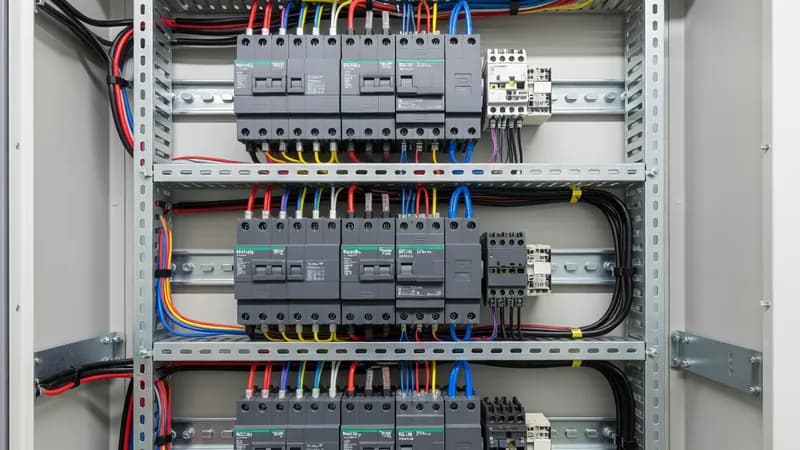
Overview
Moulded Case Circuit Breakers (MCCB) are a core outgoing and incomer protection device in Power Control Center (PCC) assemblies, where high-load feeders, motor loads, distribution transformers, capacitor banks, and large process auxiliaries must be switched and protected reliably. In IEC 61439-2 low-voltage switchgear assemblies, MCCBs are typically applied from 16 A up to 1600 A in compact panel sections, with higher frame sizes used for main incomers and bus-tie duties depending on busbar design, ventilation, and temperature-rise verification. Selection must consider rated operational current In, rated insulation voltage Ui, rated impulse withstand voltage Uimp, breaking capacity Icu/Ics, and the assembly short-circuit withstand rating Icw of the PCC. For industrial service, common MCCB interrupting capacities range from 25 kA to 100 kA at 415 V AC, but the final selection must be coordinated with prospective fault current at the point of installation and the panel’s verified short-circuit performance. In PCC applications, thermal-magnetic MCCBs suit straightforward feeder protection, while electronic trip MCCBs are preferred for incomers, generator incomers, capacitor feeders, and critical process loads because they provide adjustable long-time, short-time, instantaneous, and ground-fault functions. These settings support selectivity with upstream ACBs and downstream MCCBs, helping maintain continuity of service under IEC 60947-2 coordination principles. Where motor feeders include direct-on-line starters, soft starters, or VFDs, MCCB settings must be coordinated with inrush, harmonics, and drive input recommendations to avoid nuisance tripping while maintaining fault protection. A PCC containing MCCBs must be engineered as a complete IEC 61439 assembly, not as a collection of isolated devices. Busbar rating, feeder density, compartmentation, form of separation, and wiring space all influence temperature rise and derating. Depending on the design, Form 2, Form 3b, or Form 4 separation may be used to improve maintainability and limit fault propagation between functional units. Terminals, phase barriers, door interlocks, shrouds, and arc-resistant containment features may be added where higher operational safety is required. For harsh industrial environments, pollution degree, altitude, ambient temperature, and enclosure IP rating also affect MCCB performance and should be reflected in the design verification dossier. Modern PCC assemblies increasingly use communication-ready MCCBs with Modbus, Profibus, or Ethernet-based gateways for SCADA and BMS integration. These smart trip units enable remote status, energy metering, event logs, maintenance alarms, and load profiling, which are especially valuable in water treatment plants, utility substations, manufacturing lines, commercial towers, and infrastructure projects. Where hazardous areas or special atmospheres exist, the overall installation may require additional conformity assessment against IEC 60079, while fire performance and internal arc considerations may involve IEC 61641 for certain metal-enclosed arrangements. Patrion designs and manufactures MCCB-based PCC panels in Turkey for EPC contractors, OEMs, and facility operators requiring dependable low-voltage distribution. Typical engineered solutions include 400 A to 1600 A incomers, outgoing feeder groups for process motors and distribution boards, motor control coordination with VFDs and soft starters, and selective tripping schemes for mission-critical loads. Proper MCCB integration in a PCC is ultimately about verified coordination, thermal integrity, and short-circuit resilience within the validated IEC 61439 envelope.
Key Features
- Moulded Case Circuit Breakers (MCCB) rated for Power Control Center (PCC) operating conditions
- IEC 61439 compliant integration and coordination
- Thermal management within panel enclosure limits
- Communication-ready for SCADA/BMS integration
- Coordination with upstream and downstream protection devices
Specifications
| Property | Value |
|---|---|
| Panel Type | Power Control Center (PCC) |
| Component | Moulded Case Circuit Breakers (MCCB) |
| Standard | IEC 61439-2 |
| Integration | Type-tested coordination |
Other Components for Power Control Center (PCC)
Main incoming/outgoing protection, 630A–6300A, draw-out mounting
Copper/aluminum busbars, busbar supports, tap-off units
Energy meters, power quality analyzers, CT/VT, communication gateways
Overcurrent, earth fault, differential, generator protection relays
Type 1/2/3 surge arresters, coordination, monitoring
Other Panels Using Moulded Case Circuit Breakers (MCCB)
Primary power distribution from transformer to sub-circuits. Rated up to 6300A. Houses main incoming breaker, bus-section, and outgoing feeders.
Centralized motor control with starters, contactors, overloads, and VFDs in standardized withdrawable/fixed functional units.
Automatic capacitor switching for reactive power compensation. Thyristor or contactor-switched, detuned or standard configurations.
Automatic changeover between mains and generator/UPS. Open or closed transition, with or without bypass.
Enclosed VFD assemblies with input protection, line reactors, EMC filters, output reactors, and bypass options.
Genset start/stop sequencing, synchronization, load sharing, and paralleling controls.
Energy metering, power quality analysis, and multi-circuit monitoring with communication gateways.
Final distribution for lighting and small power. MCB/RCBO-based with DALI or KNX integration options.
Prefabricated busbar distribution per IEC 61439-6. Sandwich or air-insulated, aluminum or copper.
Process and machine control panels housing PLCs, I/O modules, relays, HMIs, and communication infrastructure.
Bespoke panel assemblies for non-standard requirements — special ratings, unusual form factors, multi-function combinations.
Enclosed soft starter assemblies for reduced voltage motor starting with torque control, ramp-up/down profiles, and bypass contactor options.
Active or passive harmonic filtering to mitigate THD from non-linear loads. Tuned LC filters, active filters, or hybrid configurations.
DC power distribution for battery systems, solar installations, telecom, and UPS applications. MCCB/fuse-based DC protection.
Fixed or automatic capacitor bank assemblies for bulk reactive power compensation in industrial and utility applications.
Frequently Asked Questions
Ready to Engineer Your Next Panel?
Our team of electrical engineers is ready to design, build, and deliver your custom panel solution — fully compliant with international standards.