Busbar Systems in Power Control Center (PCC)
Busbar Systems selection, integration, and best practices for Power Control Center (PCC) assemblies compliant with IEC 61439.
Overview
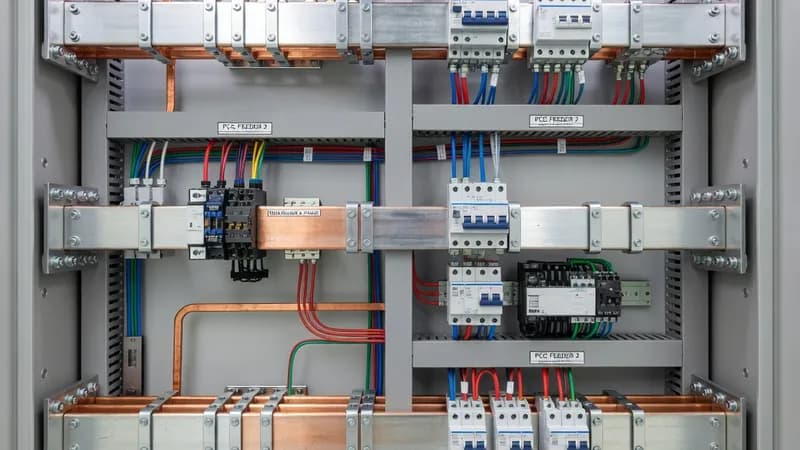
Busbar systems are the backbone of a Power Control Center (PCC), carrying the full distribution current from the incoming feeder section to multiple outgoing functional units while maintaining mechanical rigidity, thermal stability, and short-circuit withstand capability. In IEC 61439-2 assemblies, the busbar design must be verified for rated current, temperature-rise limits, dielectric properties, and short-circuit performance as part of the complete panel system rather than as isolated components. For PCC applications, this typically means copper or aluminum main busbars, neutral bars, and protective earth bars selected according to the assembly’s rated operational current, commonly in the range of 800 A to 6300 A, with short-time withstand values often specified from 25 kA to 100 kA for 1 s depending on the upstream transformer and fault level. A properly engineered PCC busbar system includes phase bars, supports, insulation barriers, shrouds, joints, and busbar chambers designed to control spacing, minimize hotspots, and reduce partial discharge risk under heavy loading. Busbar support spacing, cross-section sizing, and joint bolting torque must be coordinated with the manufacturer’s verified design data under IEC 61439-1/2, including temperature-rise verification and protection against electric shock. In high-density switchboards, laminated or edgewise busbar arrangements may be used to improve current distribution and reduce inductive reactance, especially where large ACB incomers and bus couplers operate in parallel with multiple MCCB feeders. Where harmonic loads from VFDs, soft starters, UPS systems, or nonlinear process equipment are present, neutral sizing and derating strategy become critical to prevent overheating and resonance effects. Power Control Centers frequently incorporate draw-out ACBs, fixed or plug-in MCCBs, metering blocks, protection relays, CTs, and communication gateways for SCADA or BMS monitoring. The busbar layout must accommodate these devices with appropriate segregation and form of internal separation, typically Form 2b, Form 3b, or Form 4 where operational continuity and maintenance safety are priorities. Busbar chambers may be isolated from functional units to maintain personnel protection and improve fault containment. Coordination with upstream protection devices and downstream feeder breakers is essential to ensure discrimination, selectivity, and energy limitation. In critical industrial plants, the busbar system must also support bus couplers, automatic transfer schemes, and future expansion capacity without exceeding thermal or mechanical design limits. For industrial environments with elevated fault levels, the busbar system must be verified for short-circuit withstand, peak withstand current, and mechanical stability during fault forces. If the PCC is installed in hazardous areas or near process plants, enclosure and component selection may also need to consider IEC 60079 requirements for explosive atmospheres, while arc-fault containment expectations may reference IEC/TR 61641 for low-voltage switchgear assemblies. Patrion designs and manufactures PCC busbar systems with engineered copper busbar assemblies, custom supports, phase barriers, and assembly-level verification to IEC 61439, ensuring reliable integration with main incomer ACBs, outgoing MCCB groups, intelligent power meters, and communications-ready monitoring architectures. This approach is particularly effective in data centers, water treatment plants, manufacturing lines, utility substations, and large commercial complexes where uptime, maintainability, and verified performance are mandatory.
Key Features
- Busbar Systems rated for Power Control Center (PCC) operating conditions
- IEC 61439 compliant integration and coordination
- Thermal management within panel enclosure limits
- Communication-ready for SCADA/BMS integration
- Coordination with upstream and downstream protection devices
Specifications
| Property | Value |
|---|---|
| Panel Type | Power Control Center (PCC) |
| Component | Busbar Systems |
| Standard | IEC 61439-2 |
| Integration | Type-tested coordination |
Other Components for Power Control Center (PCC)
Main incoming/outgoing protection, 630A–6300A, draw-out mounting
Branch protection 16A–1600A, thermal-magnetic or electronic trip
Energy meters, power quality analyzers, CT/VT, communication gateways
Overcurrent, earth fault, differential, generator protection relays
Type 1/2/3 surge arresters, coordination, monitoring
Other Panels Using Busbar Systems
Primary power distribution from transformer to sub-circuits. Rated up to 6300A. Houses main incoming breaker, bus-section, and outgoing feeders.
Centralized motor control with starters, contactors, overloads, and VFDs in standardized withdrawable/fixed functional units.
Enclosed VFD assemblies with input protection, line reactors, EMC filters, output reactors, and bypass options.
Energy metering, power quality analysis, and multi-circuit monitoring with communication gateways.
Final distribution for lighting and small power. MCB/RCBO-based with DALI or KNX integration options.
Prefabricated busbar distribution per IEC 61439-6. Sandwich or air-insulated, aluminum or copper.
Bespoke panel assemblies for non-standard requirements — special ratings, unusual form factors, multi-function combinations.
Enclosed soft starter assemblies for reduced voltage motor starting with torque control, ramp-up/down profiles, and bypass contactor options.
DC power distribution for battery systems, solar installations, telecom, and UPS applications. MCCB/fuse-based DC protection.
Fixed or automatic capacitor bank assemblies for bulk reactive power compensation in industrial and utility applications.
Frequently Asked Questions
Ready to Engineer Your Next Panel?
Our team of electrical engineers is ready to design, build, and deliver your custom panel solution — fully compliant with international standards.