Protection Relays in Power Control Center (PCC)
Protection Relays selection, integration, and best practices for Power Control Center (PCC) assemblies compliant with IEC 61439.
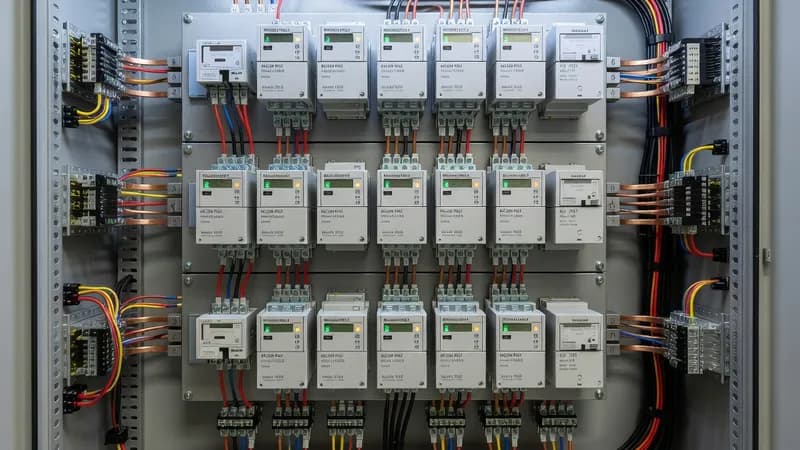
Overview
Protection relays are a core intelligence layer in Power Control Center (PCC) assemblies, where incoming, bus-coupler, and feeder circuits must be monitored and tripped with high selectivity and fast fault clearing. In a typical PCC built to IEC 61439-2, relays are used alongside ACBs, MCCBs, CTs, VTs, shunt trips, and auxiliary contacts to implement overcurrent, earth-fault, undervoltage, phase loss, reverse power, differential, and generator protection. For utility or industrial feeders, multifunction numerical relays from established platforms such as Siemens SIPROTEC, Schneider Electric Easergy, ABB Relion, or Sepam-class devices are commonly applied where metering, event logging, and IEC 61850 communication are required. Selection starts with the network architecture and protection philosophy. Relay pickup settings must coordinate with upstream transformers, busbar fault levels, and downstream MCCB/MCB curves so that the PCC achieves discrimination without nuisance tripping. In many installations, the incoming ACB may be rated 1600 A to 6300 A, while feeder protection relays supervise circuits from 63 A up to several thousand amperes through external CT ratios such as 100/5, 800/5, or 3000/1. The relay burden, CT accuracy class, and thermal rating must be matched to the measurement and protection objective. For generator incomers, reverse power and loss-of-mains functions may be essential; for capacitor banks, unbalance and overcurrent supervision are typical. From an IEC standpoint, the complete PCC assembly must satisfy IEC 61439-1 and IEC 61439-2 for design verification, including temperature-rise limits, dielectric properties, short-circuit withstand, and clearances. Protection relays themselves are typically specified and tested under IEC 60255, while the associated switching devices are governed by IEC 60947-2 for circuit-breakers and IEC 60947-6-1 for transfer and automatic switching equipment where applicable. If the PCC is installed in hazardous or corrosive locations, enclosure and installation interfaces may also require consideration of IEC 60079 or anti-condensation measures, and arc-flash containment approaches may reference IEC 61641 where internal arc risk mitigation is part of the design brief. Thermal management is critical because protection relays add internal heat, especially when combined with communication modules, I/O expansion, gateways, and power supplies. Relay mounting should preserve enclosure airflow, with derating applied when ambient temperature exceeds 40°C or when the PCC is densely populated with ACBs, VFDs, soft starters, or metering equipment. In practice, segregation and form of separation, often Form 2b, Form 3b, or Form 4a depending on serviceability requirements, help limit fault propagation and maintain maintainability during operation. For digital integration, protection relays should support Modbus RTU/TCP, Profibus, Profinet, Ethernet/IP, or IEC 61850 where SCADA and BMS connectivity is required. Time-stamped fault records, disturbance files, and SOE functions are valuable for EPC handover and plant maintenance teams. Patrion’s PCC panel assemblies are engineered to integrate these relays with coordinated protection logic, verified wiring, and busbar short-circuit ratings up to the project requirement, ensuring reliable operation in power plants, process industries, water treatment facilities, commercial campuses, and critical infrastructure switchrooms.
Key Features
- Protection Relays rated for Power Control Center (PCC) operating conditions
- IEC 61439 compliant integration and coordination
- Thermal management within panel enclosure limits
- Communication-ready for SCADA/BMS integration
- Coordination with upstream and downstream protection devices
Specifications
| Property | Value |
|---|---|
| Panel Type | Power Control Center (PCC) |
| Component | Protection Relays |
| Standard | IEC 61439-2 |
| Integration | Type-tested coordination |
Other Components for Power Control Center (PCC)
Main incoming/outgoing protection, 630A–6300A, draw-out mounting
Branch protection 16A–1600A, thermal-magnetic or electronic trip
Copper/aluminum busbars, busbar supports, tap-off units
Energy meters, power quality analyzers, CT/VT, communication gateways
Type 1/2/3 surge arresters, coordination, monitoring
Other Panels Using Protection Relays
Primary power distribution from transformer to sub-circuits. Rated up to 6300A. Houses main incoming breaker, bus-section, and outgoing feeders.
Centralized motor control with starters, contactors, overloads, and VFDs in standardized withdrawable/fixed functional units.
Automatic capacitor switching for reactive power compensation. Thyristor or contactor-switched, detuned or standard configurations.
Automatic changeover between mains and generator/UPS. Open or closed transition, with or without bypass.
Genset start/stop sequencing, synchronization, load sharing, and paralleling controls.
Process and machine control panels housing PLCs, I/O modules, relays, HMIs, and communication infrastructure.
Bespoke panel assemblies for non-standard requirements — special ratings, unusual form factors, multi-function combinations.
Enclosed soft starter assemblies for reduced voltage motor starting with torque control, ramp-up/down profiles, and bypass contactor options.
Active or passive harmonic filtering to mitigate THD from non-linear loads. Tuned LC filters, active filters, or hybrid configurations.
DC power distribution for battery systems, solar installations, telecom, and UPS applications. MCCB/fuse-based DC protection.
Fixed or automatic capacitor bank assemblies for bulk reactive power compensation in industrial and utility applications.
Frequently Asked Questions
Ready to Engineer Your Next Panel?
Our team of electrical engineers is ready to design, build, and deliver your custom panel solution — fully compliant with international standards.