Commercial Buildings
MDB, lighting distribution, APFC, ATS, metering, BTS, capacitor bank, BMS integration
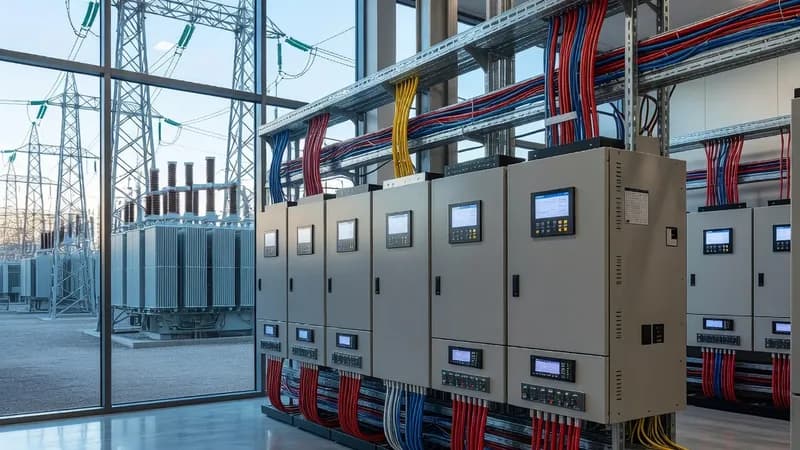
Commercial buildings such as office towers, retail malls, hotels, airports, hospitals, universities, and mixed-use developments require low-voltage switchgear that balances continuity of service, energy efficiency, maintainability, and compact installation footprint. In this sector, the electrical architecture typically starts with a main distribution board (MDB) built around ACBs or high-frame MCCBs, feeding sub-main distribution boards, lighting distribution boards, power-factor-correction panels, ATS panels, metering panels, and busbar trunking systems. Depending on demand profile, incomers may be rated from 250 A to 6300 A, with busbars and protective devices selected for prospective short-circuit withstand levels commonly in the range of 25 kA to 100 kA for 1 s, or higher where utility fault levels dictate. Form 2, Form 3, and Form 4 separation per IEC 61439 are often specified to improve operational safety, maintenance continuity, and fault containment in high-occupancy environments. Commercial building panels must support a wide mix of loads: HVAC chillers and pumps, lifts, escalators, plug loads, LED lighting, domestic water systems, emergency services, kitchen equipment, and tenant-specific equipment. This creates a need for selective coordination between ACBs, MCCBs, MCBs, earth-fault relays, and protection relays to prevent nuisance tripping and protect critical services. For motor loads and variable torque applications, VFDs and soft starters are commonly integrated into dedicated MCC sections or packaged control panels, while capacitor banks and APFC controllers reduce reactive power penalties and stabilize the building’s power factor under varying occupancy. Power analyzers, multifunction meters, surge protection devices, and smart communication gateways enable BMS integration via Modbus, BACnet, KNX, or similar protocols. Environmental and installation conditions are also important. Panels are often placed in electrical rooms, risers, basements, plant rooms, or rooftop enclosures, so enclosure selection must consider IP protection ratings, corrosion resistance, ventilation, internal temperature rise, and accessibility for maintenance staff. Where panels are installed in public or semi-public areas, tamper resistance and clear segregation of accessible circuits become critical. For smoke control, life safety, and fire-fighting systems, special attention is given to continuity of supply, cable routing, and emergency operation in line with IEC 61439-1 and IEC 61439-2, while distribution boards intended for ordinary persons typically require IEC 61439-3 compliance. For buildings with critical transfer requirements, ATS panels are engineered for source monitoring, mechanical/electrical interlocking, and transfer logic to support standby generators or dual utility supplies. In regions or projects demanding additional safety measures, panel assemblies may also reference IEC 61641 for internal arcing fault mitigation and IEC 60079 where hazardous areas are adjacent to certain commercial facilities. The use of proven component ecosystems from IEC 60947-compliant devices such as contactors, motor starters, disconnectors, and protective relays improves interoperability and documentation traceability. Patrion designs and manufactures commercial building switchboards, MDBs, lighting distribution boards, capacitor bank panels, ATS panels, metering panels, and custom-engineered assemblies to suit international EPC specifications, LEED/BREEAM energy targets, and utility metering requirements, delivering compact, maintainable, and standards-compliant solutions for modern buildings.
Panel Types for This Industry
Main Distribution Board (MDB) assemblies engineered for Commercial Buildings applications, addressing industry-specific requirements and compliance standards.
Lighting Distribution Board assemblies engineered for Commercial Buildings applications, addressing industry-specific requirements and compliance standards.
Power Factor Correction Panel (APFC) assemblies engineered for Commercial Buildings applications, addressing industry-specific requirements and compliance standards.
Automatic Transfer Switch (ATS) Panel assemblies engineered for Commercial Buildings applications, addressing industry-specific requirements and compliance standards.
Metering & Monitoring Panel assemblies engineered for Commercial Buildings applications, addressing industry-specific requirements and compliance standards.
Busbar Trunking System (BTS) assemblies engineered for Commercial Buildings applications, addressing industry-specific requirements and compliance standards.
Capacitor Bank Panel assemblies engineered for Commercial Buildings applications, addressing industry-specific requirements and compliance standards.
Custom Engineered Panel assemblies engineered for Commercial Buildings applications, addressing industry-specific requirements and compliance standards.
Frequently Asked Questions
Ready to Engineer Your Next Panel?
Our team of electrical engineers is ready to design, build, and deliver your custom panel solution — fully compliant with international standards.