Main Distribution Board (MDB) for Commercial Buildings
Main Distribution Board (MDB) assemblies engineered for Commercial Buildings applications, addressing industry-specific requirements and compliance standards.
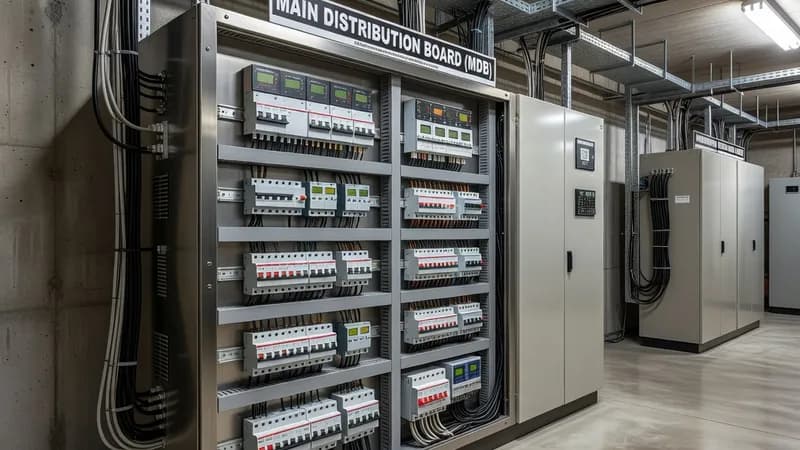
Overview
Main Distribution Board (MDB) assemblies for commercial buildings are the primary low-voltage switchgear interface between the utility transformer, standby generators, photovoltaic inverters, and downstream final distribution circuits. Designed and verified in accordance with IEC 61439-1 and IEC 61439-2, these assemblies typically incorporate ACB incomers up to 6300 A, MCCB feeders, busbar systems rated for high short-circuit withstand, and metering sections for tenant and whole-building energy accountability. In multi-tenant offices, shopping centers, hospitals, hotels, and mixed-use towers, the MDB must deliver reliable segregation, maintainability, and fault containment while supporting continuous operation and planned expansions. Commercial building MDBs often include air circuit breakers with electronic trip units, molded case circuit breakers for outgoing feeders, power factor correction banks with capacitor steps and detuned reactors, automatic transfer switch functions for generator changeover, and multifunction power meters for revenue-grade or submetering use. For building automation, the MDB may integrate protection relays, communication gateways, and BMS interfaces using Modbus TCP, Modbus RTU, BACnet, or IEC 61850 where required. If the project includes HVAC plant, chilled water pumps, lifts, escalators, or smoke extraction fans, the MDB may also supply VFDs and soft starters in dedicated compartments or adjacent MCC sections to reduce inrush current and improve energy efficiency. Environmental and installation conditions in commercial buildings vary widely, so enclosure selection must reflect indoor temperatures, ventilation strategy, dust ingress, and maintenance access. Typical protection degrees range from IP31 to IP54 depending on plantroom conditions, with corrosion-resistant coatings and suitable busbar insulation for humid basement locations or coastal projects. Where arc-risk mitigation is required, designers may apply internal arc containment concepts verified to IEC/TR 61641, and flame resistance considerations under IEC 60695 where appropriate. In areas with explosive atmospheres such as fuel storage or specialist utility rooms, associated equipment must be evaluated against IEC 60079 requirements, although the MDB itself is usually installed outside hazardous zones. Good MDB design also depends on forms of separation under IEC 61439, commonly Form 2, Form 3b, or Form 4b, to improve service continuity and isolate feeder maintenance without shutting down the entire board. Selection of copper busbars, vertical and horizontal segregation, cable alley sizing, and thermal derating must be coordinated with ambient conditions and diversity factors. Short-circuit ratings are project-specific and may range from 25 kA to 100 kA or higher for 1 second, based on transformer fault level and upstream protection coordination. Engineers should verify temperature rise, protective device discrimination, and loop impedance to ensure selective tripping between ACB incomers, MCCB subfeeders, and final circuit protection. For EPC contractors, facility managers, and electrical consultants, commercial building MDBs are most effective when the design includes accurate single-line diagrams, load schedules, future spare capacity, arc-flash labeling, and documented routine maintenance access. Patrion’s MDB assemblies can be engineered for lighting distribution, HVAC, tenant metering, APFC, ATS, generator integration, and BMS connectivity, with tested configurations aligned to IEC 61439-2 and related component standards such as IEC 60947 for switchgear devices. The result is a robust, scalable distribution core that supports safe operation, energy management, and long-term asset performance in demanding commercial environments.
Key Features
- Main Distribution Board (MDB) configured for Commercial Buildings requirements
- Industry-specific environmental ratings and protections
- Compliance with sector-specific standards and regulations
- Optimized component selection for industry applications
- Integration with industry-standard control and monitoring systems
Specifications
| Property | Value |
|---|---|
| Panel Type | Main Distribution Board (MDB) |
| Industry | Commercial Buildings |
| Base Standard | IEC 61439-2 |
| Environment | Industry-specific ratings |
Other Panels for Commercial Buildings
Final distribution for lighting and small power. MCB/RCBO-based with DALI or KNX integration options.
Automatic capacitor switching for reactive power compensation. Thyristor or contactor-switched, detuned or standard configurations.
Automatic changeover between mains and generator/UPS. Open or closed transition, with or without bypass.
Energy metering, power quality analysis, and multi-circuit monitoring with communication gateways.
Prefabricated busbar distribution per IEC 61439-6. Sandwich or air-insulated, aluminum or copper.
Fixed or automatic capacitor bank assemblies for bulk reactive power compensation in industrial and utility applications.
Bespoke panel assemblies for non-standard requirements — special ratings, unusual form factors, multi-function combinations.
Other Industries Using Main Distribution Board (MDB)
MCC, PCC, VFD panels, MDB, APFC, automation panels, soft starters, harmonic filters, capacitor banks — full range
High-reliability MDB, PCC, ATS (STS), metering, APFC, BTS, DC distribution
ATS (critical power), MDB, generator control, lighting, metering, APFC
Ex-rated panels, MCC, PCC, VFD, generator control, soft starters, ATEX/IECEx compliance
MCC, VFD panels, PLC automation, APFC, generator control, soft starters
Rugged MCC, PCC, VFD panels, generator panels, soft starters, harmonic filters
MDB, metering, APFC, ATS, PLC, DC distribution, capacitor banks
Marine-certified panels, MCC, generator sync, ATS, PLC, classification society compliance
MDB, ATS, metering, BTS, lighting distribution, DC distribution
Washdown-rated panels (IP65+), MCC, VFD, APFC, PLC, soft starters, harmonic filters
Cleanroom-compatible panels, MCC, VFD, APFC, PLC, soft starters, harmonic filters
Frequently Asked Questions
Ready to Engineer Your Next Panel?
Our team of electrical engineers is ready to design, build, and deliver your custom panel solution — fully compliant with international standards.