Power Factor Correction Panel (APFC) for Commercial Buildings
Power Factor Correction Panel (APFC) assemblies engineered for Commercial Buildings applications, addressing industry-specific requirements and compliance standards.
Overview
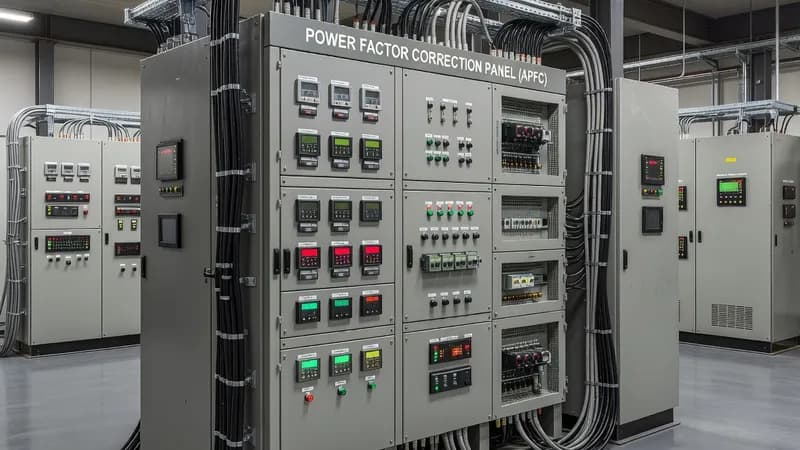
Power Factor Correction Panel (APFC) assemblies for commercial buildings are engineered to improve power quality, reduce kVA demand, and maintain compliance with utility power factor requirements across malls, office towers, hospitals, airports, hotels, and mixed-use developments. In modern low-voltage distribution systems, an APFC panel is typically connected to the main LV switchboard or to a dedicated busbar section and automatically switches capacitor stages using a reactive power controller, current transformer, and step contactors or thyristor modules. Typical configurations include 6 to 18 steps, with total compensation ranging from 50 kVAr to several Mvar, depending on transformer size, load profile, and harmonic content. For commercial buildings, IEC 61439-1 and IEC 61439-2 define the design verification and type-verified assembly requirements for the enclosure, busbar system, temperature rise, dielectric performance, short-circuit withstand, and internal separation. Where the APFC panel is integrated into an MDB or metering lineup, IEC 61439-3 may apply for distribution boards, while IEC 61439-6 is relevant when the assembly interfaces with busbar trunking. Component selection must also align with IEC 60947-4-1 for contactors and motor-rated switching devices, IEC 60947-2 for MCCBs and incomers, and IEC 60947-1 for general rules. In buildings with fire- and smoke-critical spaces, enclosure performance may also be assessed against IEC 61641 for arcing fault containment, while special rooms in petrol-adjacent or explosive-risk utility zones may require consideration of IEC 60079. A well-designed commercial APFC panel typically includes capacitor duty contactors, detuned reactors, discharge resistors, fused step protection, APC-rated capacitors, protection relays, harmonic filters, ventilation fans, thermostats, and door-mounted HMI or power analyzers. In facilities with variable-speed drives, elevators, chillers, and UPS systems, harmonic distortion is often high, so detuned reactors tuned to 189 Hz or 210 Hz are used to avoid resonance and capacitor overload. Where fast load changes occur, thyristor-switched steps can be used instead of mechanical contactors to improve response and reduce wear. Main incomers are commonly protected by MCCBs or ACBs with suitable short-circuit ratings, such as 25 kA, 36 kA, 50 kA, or higher depending on prospective fault level and coordination study. Commercial buildings also demand robust integration with BMS and metering systems. APFC controllers can provide Modbus RTU/TCP, BACnet gateway integration, remote alarms, capacitor step status, THDv/THDi monitoring, and kWh/kVArh trend data for energy audits. Enclosures are often manufactured to IP31, IP42, IP54, or higher depending on location, dust exposure, and HVAC conditions. For indoor plant rooms, thermal management is crucial because capacitor life is strongly affected by ambient temperature and ventilation. Panels are commonly built with Form 2, Form 3b, or Form 4 internal separation where segregation of functional units, busbars, and terminals is required for maintainability and service continuity. Patrion designs and manufactures APFC panels for commercial buildings as IEC 61439-compliant assemblies, with application-specific engineering for transformer-fed systems, generator backup compatibility, and utility penalty reduction. Each solution is configured around the actual load profile, measured harmonic spectrum, available fault level, and building automation requirements to ensure stable compensation, long service life, and dependable operational savings.
Key Features
- Power Factor Correction Panel (APFC) configured for Commercial Buildings requirements
- Industry-specific environmental ratings and protections
- Compliance with sector-specific standards and regulations
- Optimized component selection for industry applications
- Integration with industry-standard control and monitoring systems
Specifications
| Property | Value |
|---|---|
| Panel Type | Power Factor Correction Panel (APFC) |
| Industry | Commercial Buildings |
| Base Standard | IEC 61439-2 |
| Environment | Industry-specific ratings |
Other Panels for Commercial Buildings
Primary power distribution from transformer to sub-circuits. Rated up to 6300A. Houses main incoming breaker, bus-section, and outgoing feeders.
Final distribution for lighting and small power. MCB/RCBO-based with DALI or KNX integration options.
Automatic changeover between mains and generator/UPS. Open or closed transition, with or without bypass.
Energy metering, power quality analysis, and multi-circuit monitoring with communication gateways.
Prefabricated busbar distribution per IEC 61439-6. Sandwich or air-insulated, aluminum or copper.
Fixed or automatic capacitor bank assemblies for bulk reactive power compensation in industrial and utility applications.
Bespoke panel assemblies for non-standard requirements — special ratings, unusual form factors, multi-function combinations.
Other Industries Using Power Factor Correction Panel (APFC)
MCC, PCC, VFD panels, MDB, APFC, automation panels, soft starters, harmonic filters, capacitor banks — full range
High-reliability MDB, PCC, ATS (STS), metering, APFC, BTS, DC distribution
ATS (critical power), MDB, generator control, lighting, metering, APFC
MCC, VFD panels, PLC automation, APFC, generator control, soft starters
MDB, metering, APFC, ATS, PLC, DC distribution, capacitor banks
Washdown-rated panels (IP65+), MCC, VFD, APFC, PLC, soft starters, harmonic filters
Cleanroom-compatible panels, MCC, VFD, APFC, PLC, soft starters, harmonic filters
Frequently Asked Questions
Ready to Engineer Your Next Panel?
Our team of electrical engineers is ready to design, build, and deliver your custom panel solution — fully compliant with international standards.