Industrial Manufacturing
MCC, PCC, VFD panels, MDB, APFC, automation panels, soft starters, harmonic filters, capacitor banks — full range
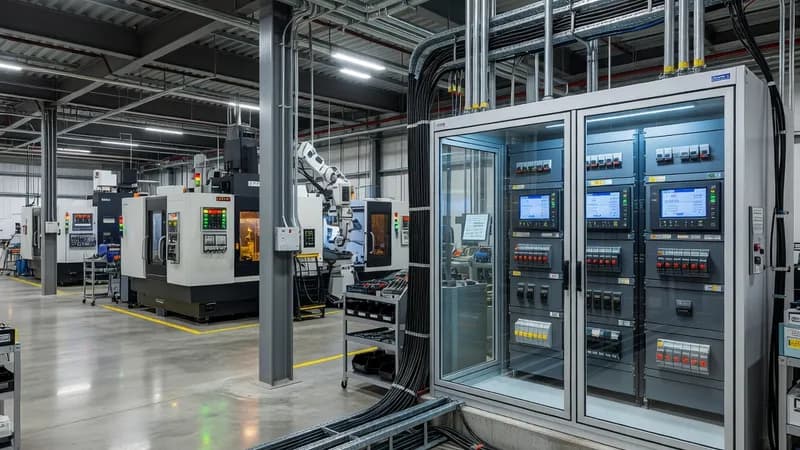
Industrial manufacturing facilities depend on robust low-voltage switchgear and controlgear assemblies to maintain uptime, product quality, and process safety across continuous, batch, and discrete production lines. Typical installations include main distribution boards (MDBs), power control centers (PCCs), motor control centers (MCCs), variable frequency drive (VFD) panels, soft starter panels, automatic power factor correction (APFC) panels, PLC automation panels, metering panels, harmonic filter panels, capacitor bank panels, and custom engineered assemblies integrating busbar trunking interfaces and feeder sections. These systems are commonly designed in accordance with IEC 61439-1 and IEC 61439-2 for power switchgear assemblies, with functional units and feeder groups arranged to support maintainability, segregation, and heat management. Where metering and building services are involved, IEC 61439-3 and IEC 61439-6 may also be relevant, particularly for distribution boards and busbar trunking systems used to feed production areas, utilities, and auxiliary loads. In industrial plants, rated currents often range from 63 A in control panels to 4000 A or higher in MDB and PCC assemblies, depending on installed transformer capacity and process diversity. Short-circuit withstand performance is a key design parameter, with assemblies specified for conditional short-circuit current ratings and prospective fault levels commonly from 25 kA to 100 kA or more, verified by type-tested or design-verified construction in line with IEC 61439. Air circuit breakers (ACBs) are typically used for incomers and bus couplers, while moulded-case circuit breakers (MCCBs) protect outgoing feeders and process auxiliaries. Motor feeders may combine contactors, motor protection breakers, overload relays, soft starters, or VFDs depending on starting torque, load profile, and energy efficiency targets. Protection relays are added for generator interfaces, large motors, transformer protection, and selective coordination. Industrial manufacturing environments impose demanding thermal, mechanical, and electromagnetic conditions. Panels must accommodate high ambient temperatures, dust ingress, vibration, washdown exposure, and corrosive atmospheres from welding, machining, food processing, chemical handling, or finishing lines. Therefore, enclosure selection, ventilation strategy, IP protection ratings, cable entry design, and internal segregation are critical. Form 1, Form 2, Form 3, and Form 4 separation are used to reduce arc propagation risk, improve service continuity, and permit maintenance on live systems where allowed by operating procedures. For high-energy installations, arc containment and internal arcing verification per IEC 61641 can be important, especially in MCCs and PCCs located in occupied plantrooms. Power quality is another major concern. Large numbers of VFDs, welders, servo drives, induction furnaces, and switching loads can introduce harmonics, voltage dips, and reactive power penalties. APFC panels and passive or detuned capacitor banks are used to improve power factor and reduce utility charges, while harmonic filter panels and line reactors help comply with EMC requirements and mitigate distortion in accordance with IEC 61000 series practices. For motor-driven processes such as pumps, compressors, conveyors, mixers, extruders, and packaging machinery, the choice between DOL, star-delta, soft starter, and VFD control is based on process torque, inrush limitation, and lifecycle energy cost. Where hazardous atmospheres may exist, for example in solvent recovery, dust handling, or paint lines, equipment selection may also need to consider IEC 60079 requirements for explosive atmospheres. In all cases, the final assembly should be validated for temperature rise, dielectric properties, clearances and creepage distances, short-circuit performance, and continuity of protective circuits. For EPC contractors, factory acceptance testing, wiring verification, secondary injection testing, and documentation are essential deliverables. For facility managers, maintainable layouts, spare feeder space, metering visibility, and scalable architectures reduce downtime and support future expansion. Patrion, based in Turkey, supplies engineered industrial switchgear panels tailored to these requirements with IEC-compliant design, manufacturing, and testing for global manufacturing applications.
Panel Types for This Industry
Main Distribution Board (MDB) assemblies engineered for Industrial Manufacturing applications, addressing industry-specific requirements and compliance standards.
Power Control Center (PCC) assemblies engineered for Industrial Manufacturing applications, addressing industry-specific requirements and compliance standards.
Motor Control Center (MCC) assemblies engineered for Industrial Manufacturing applications, addressing industry-specific requirements and compliance standards.
Power Factor Correction Panel (APFC) assemblies engineered for Industrial Manufacturing applications, addressing industry-specific requirements and compliance standards.
Automatic Transfer Switch (ATS) Panel assemblies engineered for Industrial Manufacturing applications, addressing industry-specific requirements and compliance standards.
Variable Frequency Drive (VFD) Panel assemblies engineered for Industrial Manufacturing applications, addressing industry-specific requirements and compliance standards.
Metering & Monitoring Panel assemblies engineered for Industrial Manufacturing applications, addressing industry-specific requirements and compliance standards.
PLC & Automation Control Panel assemblies engineered for Industrial Manufacturing applications, addressing industry-specific requirements and compliance standards.
Busbar Trunking System (BTS) assemblies engineered for Industrial Manufacturing applications, addressing industry-specific requirements and compliance standards.
Soft Starter Panel assemblies engineered for Industrial Manufacturing applications, addressing industry-specific requirements and compliance standards.
Harmonic Filter Panel assemblies engineered for Industrial Manufacturing applications, addressing industry-specific requirements and compliance standards.
Capacitor Bank Panel assemblies engineered for Industrial Manufacturing applications, addressing industry-specific requirements and compliance standards.
Custom Engineered Panel assemblies engineered for Industrial Manufacturing applications, addressing industry-specific requirements and compliance standards.
Frequently Asked Questions
Ready to Engineer Your Next Panel?
Our team of electrical engineers is ready to design, build, and deliver your custom panel solution — fully compliant with international standards.