Power Factor Correction Panel (APFC) for Industrial Manufacturing
Power Factor Correction Panel (APFC) assemblies engineered for Industrial Manufacturing applications, addressing industry-specific requirements and compliance standards.
Overview
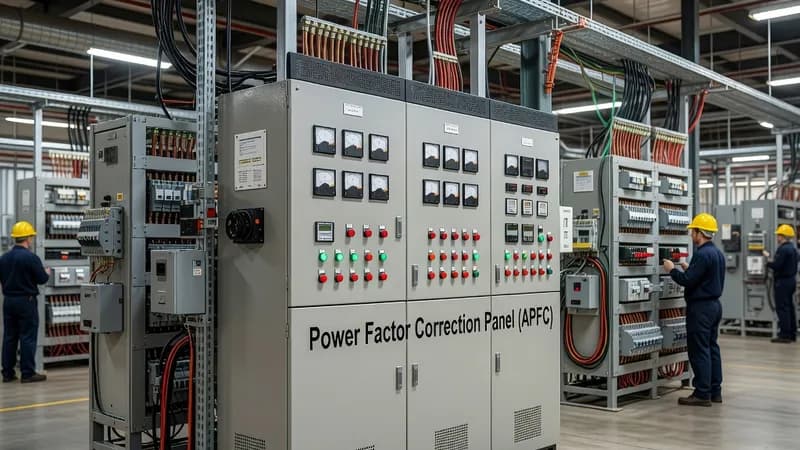
Power Factor Correction Panel (APFC) assemblies for industrial manufacturing plants are engineered to maintain target power factors, reduce reactive energy penalties, improve busbar capacity utilization, and stabilize plant voltage under highly variable production loads. In facilities with induction motors, welding stations, compressors, conveyors, extrusion lines, pumps, and VFD-driven process equipment, automated compensation is often necessary because load profiles change continuously across shifts and product batches. Modern APFC systems typically combine step capacitors, detuned or filtered reactors, discharge resistors, power factor controllers, and heavy-duty contactors or thyristor switching modules to achieve fast, accurate kVAr control without overstressing capacitors or disturbing sensitive loads. For industrial manufacturing applications, APFC panels are commonly built as IEC 61439-2 assemblies using copper busbars, temperature-rising verified enclosure layouts, and components selected to IEC 60947-4-1, IEC 60947-5-1, and IEC 60831 for capacitor duty. Depending on fault level and utility connection point, panels may be rated up to 690 V AC, with busbar currents from 250 A to 4000 A or more, and short-circuit withstand ratings such as 25 kA, 36 kA, 50 kA, or 65 kA for 1 second, subject to design verification. In plants with harmonic distortion from VFDs, servo drives, welders, or rectifier loads, detuned APFC banks with 7%, 14%, or 189 Hz reactors are frequently specified to avoid resonance and capacitor overcurrent. Where rapid load variation exists, thyristor-switched APFC steps provide millisecond response and reduce flicker compared with mechanical contactor stages. Industrial manufacturing environments also demand robust environmental protection. Enclosures are typically manufactured to IP31, IP42, IP54, or higher, with corrosion-resistant powder coating, segmented ventilation, thermostatically controlled fans, and anti-condensation heaters for humid process areas. In dusty milling, cement, textile, food processing, or packaging zones, cabinet filtration and segregated capacitor compartments help maintain dielectric life and thermal stability. If the installation is in a potentially explosive atmosphere, the panel scope must be reassessed against IEC 60079 requirements, while internal arc and explosion pressure considerations may require supplementary evaluation such as IEC 61641 for certain applications. Many manufacturers also integrate remote monitoring via Modbus RTU/TCP, Ethernet gateways, digital power meters, and alarm contacts for capacitor health, harmonics, temperature, and step availability. From a system perspective, APFC panels are normally coordinated with MDBs, PCCs, MCCs, and sub-distribution boards to improve site-wide energy performance and transformer loading. They are often deployed alongside protection relays, ACBs, MCCBs, metering, and capacitor fuse protection to ensure selective coordination and safe maintenance. In industrial manufacturing, the business case is clear: lower demand charges, reduced transformer losses, improved voltage regulation for process equipment, and increased usable electrical capacity without immediate infrastructure expansion. Properly engineered APFC panels are therefore a key part of power quality strategy for EPC contractors, panel builders, and plant engineers managing high-duty, mixed-load industrial operations.
Key Features
- Power Factor Correction Panel (APFC) configured for Industrial Manufacturing requirements
- Industry-specific environmental ratings and protections
- Compliance with sector-specific standards and regulations
- Optimized component selection for industry applications
- Integration with industry-standard control and monitoring systems
Specifications
| Property | Value |
|---|---|
| Panel Type | Power Factor Correction Panel (APFC) |
| Industry | Industrial Manufacturing |
| Base Standard | IEC 61439-2 |
| Environment | Industry-specific ratings |
Other Panels for Industrial Manufacturing
Primary power distribution from transformer to sub-circuits. Rated up to 6300A. Houses main incoming breaker, bus-section, and outgoing feeders.
High-capacity power distribution for industrial facilities. Controls and distributes incoming power to MCC, APFC, and downstream loads.
Centralized motor control with starters, contactors, overloads, and VFDs in standardized withdrawable/fixed functional units.
Automatic changeover between mains and generator/UPS. Open or closed transition, with or without bypass.
Enclosed VFD assemblies with input protection, line reactors, EMC filters, output reactors, and bypass options.
Energy metering, power quality analysis, and multi-circuit monitoring with communication gateways.
Process and machine control panels housing PLCs, I/O modules, relays, HMIs, and communication infrastructure.
Prefabricated busbar distribution per IEC 61439-6. Sandwich or air-insulated, aluminum or copper.
Enclosed soft starter assemblies for reduced voltage motor starting with torque control, ramp-up/down profiles, and bypass contactor options.
Active or passive harmonic filtering to mitigate THD from non-linear loads. Tuned LC filters, active filters, or hybrid configurations.
Fixed or automatic capacitor bank assemblies for bulk reactive power compensation in industrial and utility applications.
Bespoke panel assemblies for non-standard requirements — special ratings, unusual form factors, multi-function combinations.
Other Industries Using Power Factor Correction Panel (APFC)
MDB, lighting distribution, APFC, ATS, metering, BTS, capacitor bank, BMS integration
High-reliability MDB, PCC, ATS (STS), metering, APFC, BTS, DC distribution
ATS (critical power), MDB, generator control, lighting, metering, APFC
MCC, VFD panels, PLC automation, APFC, generator control, soft starters
MDB, metering, APFC, ATS, PLC, DC distribution, capacitor banks
Washdown-rated panels (IP65+), MCC, VFD, APFC, PLC, soft starters, harmonic filters
Cleanroom-compatible panels, MCC, VFD, APFC, PLC, soft starters, harmonic filters
Frequently Asked Questions
Ready to Engineer Your Next Panel?
Our team of electrical engineers is ready to design, build, and deliver your custom panel solution — fully compliant with international standards.