Motor Control Center (MCC) for Industrial Manufacturing
Motor Control Center (MCC) assemblies engineered for Industrial Manufacturing applications, addressing industry-specific requirements and compliance standards.
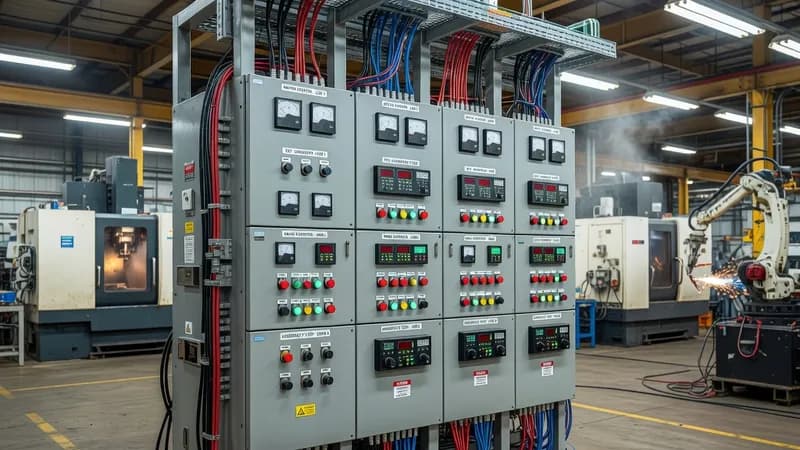
Overview
Motor Control Center (MCC) assemblies for industrial manufacturing are the central interface for motor distribution, process automation, and plant-wide protection in sectors such as automotive production, food and beverage, packaging, textiles, metals, cement, plastics, paper, and general discrete manufacturing. Built to IEC 61439-1 and IEC 61439-2, these low-voltage assemblies are engineered as verified systems, not just collections of devices, with defined ratings for temperature rise, dielectric performance, short-circuit withstand, and protective circuit integrity. In practical terms, an MCC must support everything from simple conveyor drives to continuously running compressors, mixers, extruders, pumps, fans, and critical process skids without compromising uptime or operator safety. Typical MCC architectures include incoming ACBs or MCCBs, busbar sections, vertical and horizontal distribution bars, and outgoing feeder units arranged as fixed or withdrawable drawers. Outgoing compartments may house DOL starters, reversing starters, star-delta starters, soft starters, and VFD-based feeders, selected according to starting torque, cycle frequency, energy savings targets, and process sensitivity. For higher-accuracy motor protection, electronic overload relays, multifunction protection relays, current transformers, and motor management relays are integrated to supervise phase loss, imbalance, locked rotor, earth fault, underload, and over/under-voltage conditions. In modern plants, intelligent MCCs also incorporate PLC I/O, industrial Ethernet communication, Modbus TCP, Profibus, Profinet, EtherNet/IP, and metering modules for SCADA and MES connectivity. Industrial manufacturing environments impose demanding conditions on enclosure design and thermal management. Dust, oil mist, vibration, heat, and occasional washdown require enclosure ratings such as IP31, IP42, IP54, or higher, with powder-coated steel or stainless-steel construction selected for corrosion resistance and hygiene. Internal segregation options in accordance with IEC 61439-2, including Form 2, Form 3a, Form 3b, and Form 4, help isolate functional units and reduce the spread of faults while supporting safer maintenance. For high-load plants, busbar systems are commonly rated from 630 A to 6300 A, with short-circuit ratings typically from 25 kA to 100 kA, depending on available fault level and verified design coordination. MCC temperature-rise design must also consider heat generated by VFDs, soft starters, and harmonic-rich loads, often requiring compartmentalized ventilation, forced cooling, or derating strategies. Because many manufacturing plants now use variable-speed technology extensively, harmonic mitigation has become a standard MCC design consideration. Line reactors, dv/dt filters, passive harmonic filters, and active harmonic filters are used to control THDi, reduce nuisance tripping, and protect transformers, capacitor banks, and standby generators. Where process areas are classified, interfaces must respect IEC 60079 requirements for explosive atmospheres, and arc-flash risk reduction may require arc-resistant construction, internal arc containment measures, or design practices aligned with IEC 61641. Coordination with upstream protection, selective tripping, and safe isolation points is essential for maintenance teams working under strict shutdown windows. Patrion MCC panels for industrial manufacturing can be configured as compact starter sections for small machine groups, intelligent process MCCs with remote diagnostics, or high-capacity power and motor centers serving entire production lines. Each assembly is tailored to load profile, duty cycle, ambient temperature, maintenance strategy, and expansion requirements, while being documented for verification under IEC 61439-1/2. For EPC contractors, panel builders, and facility managers, this delivers a scalable motor control platform that improves uptime, simplifies fault localization, and supports long-term operational reliability in demanding industrial environments.
Key Features
- Motor Control Center (MCC) configured for Industrial Manufacturing requirements
- Industry-specific environmental ratings and protections
- Compliance with sector-specific standards and regulations
- Optimized component selection for industry applications
- Integration with industry-standard control and monitoring systems
Specifications
| Property | Value |
|---|---|
| Panel Type | Motor Control Center (MCC) |
| Industry | Industrial Manufacturing |
| Base Standard | IEC 61439-2 |
| Environment | Industry-specific ratings |
Other Panels for Industrial Manufacturing
Primary power distribution from transformer to sub-circuits. Rated up to 6300A. Houses main incoming breaker, bus-section, and outgoing feeders.
High-capacity power distribution for industrial facilities. Controls and distributes incoming power to MCC, APFC, and downstream loads.
Automatic capacitor switching for reactive power compensation. Thyristor or contactor-switched, detuned or standard configurations.
Automatic changeover between mains and generator/UPS. Open or closed transition, with or without bypass.
Enclosed VFD assemblies with input protection, line reactors, EMC filters, output reactors, and bypass options.
Energy metering, power quality analysis, and multi-circuit monitoring with communication gateways.
Process and machine control panels housing PLCs, I/O modules, relays, HMIs, and communication infrastructure.
Prefabricated busbar distribution per IEC 61439-6. Sandwich or air-insulated, aluminum or copper.
Enclosed soft starter assemblies for reduced voltage motor starting with torque control, ramp-up/down profiles, and bypass contactor options.
Active or passive harmonic filtering to mitigate THD from non-linear loads. Tuned LC filters, active filters, or hybrid configurations.
Fixed or automatic capacitor bank assemblies for bulk reactive power compensation in industrial and utility applications.
Bespoke panel assemblies for non-standard requirements — special ratings, unusual form factors, multi-function combinations.
Other Industries Using Motor Control Center (MCC)
Ex-rated panels, MCC, PCC, VFD, generator control, soft starters, ATEX/IECEx compliance
MCC, VFD panels, PLC automation, APFC, generator control, soft starters
Rugged MCC, PCC, VFD panels, generator panels, soft starters, harmonic filters
Marine-certified panels, MCC, generator sync, ATS, PLC, classification society compliance
Washdown-rated panels (IP65+), MCC, VFD, APFC, PLC, soft starters, harmonic filters
Cleanroom-compatible panels, MCC, VFD, APFC, PLC, soft starters, harmonic filters
Frequently Asked Questions
Ready to Engineer Your Next Panel?
Our team of electrical engineers is ready to design, build, and deliver your custom panel solution — fully compliant with international standards.