Power Control Center (PCC) for Industrial Manufacturing
Power Control Center (PCC) assemblies engineered for Industrial Manufacturing applications, addressing industry-specific requirements and compliance standards.
Overview
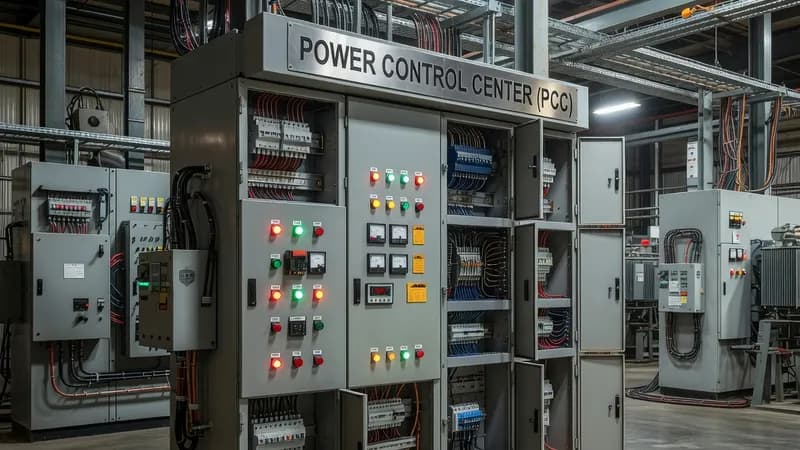
Power Control Center (PCC) assemblies for industrial manufacturing are the backbone of plant-wide power distribution, typically receiving incoming supplies from utility transformers, generators, or upstream switchboards and distributing power to production lines, utilities, HVAC, compressors, conveyors, and process equipment. In a manufacturing environment, PCCs must be designed for continuous duty, high availability, and predictable protection coordination, often with incomers based on air circuit breakers (ACBs) up to 6300 A or molded case circuit breakers (MCCBs) in lower-current systems. The assembly may include busbar systems rated for 800 A to 8000 A, with short-circuit withstand ratings commonly in the range of 25 kA to 100 kA for 1 second or higher, depending on the fault level study and utility interface. Construction and verification should follow IEC 61439-1 and IEC 61439-2, with functional compartmentation and internal separation forms such as Form 2b, Form 3b, or Form 4b selected to match maintenance philosophy, operational continuity, and arc fault containment objectives. For auxiliary sections and final distribution feeders, IEC 61439-3 may apply, while service entrances and utility interfacing often require consideration of IEC 61439-6 and local grid code requirements. Industrial manufacturing PCCs frequently integrate feeder devices such as MCCBs, fusible switch-disconnectors, contactors, overload relays, protection relays, and motor control centers, along with soft starters and variable frequency drives (VFDs) for pumps, fans, mixers, extruders, machine tools, and conveyor systems. Where process stability and energy efficiency are priorities, APFC panels with capacitor banks and detuned reactors may be incorporated to maintain power factor and reduce harmonic distortion from non-linear loads. Harmonic mitigation is especially important when VFDs, rectifiers, welding loads, UPS systems, and robotics are present, and compliance may require consideration of IEC 61000 compatibility, alongside thermal derating and busbar harmonic loading analysis. In harsh manufacturing areas such as foundries, food processing, textile plants, metalworking shops, and assembly lines, enclosure selection must address dust, moisture, oil mist, washdown, vibration, and ambient temperature, using IP ratings and corrosion-resistant finishes appropriate to the installation. In hazardous areas where flammable gases or dust may be present, interfaces with IEC 60079 requirements and segregation from Ex zones must be engineered carefully. Panel thermal design is critical in industrial facilities because high internal losses from drive systems, transformers, and power electronics can elevate internal temperatures and reduce component life. Forced ventilation, air-conditioning, heat exchangers, or segregated compartments may be required to maintain permissible operating limits. For arc-related safety, industrial PCCs may also be evaluated against IEC TR 61641 for internal arc fault behavior, especially where personnel access is frequent and the plant cannot tolerate prolonged downtime. Protection settings must be coordinated with upstream and downstream devices to ensure selective tripping, minimizing interruption to healthy feeders while isolating faults quickly. Real-world configurations often include main incomer sections, bus couplers, bus sectionalizers, feeder cubicles, VFD bays, soft starter sections, capacitor bank sections, metering compartments, and PLC/SCADA interfaces with Modbus, Profibus, Profinet, or Ethernet/IP gateways. A properly engineered PCC for industrial manufacturing is not just a distribution board; it is a system-level asset that supports production continuity, maintainability, energy monitoring, and lifecycle safety. Patrion designs and manufactures IEC-compliant PCC assemblies for Turkish and export projects, supporting EPC contractors, OEMs, and facility managers with verified designs, documentation, and factory testing tailored to industrial manufacturing requirements.
Key Features
- Power Control Center (PCC) configured for Industrial Manufacturing requirements
- Industry-specific environmental ratings and protections
- Compliance with sector-specific standards and regulations
- Optimized component selection for industry applications
- Integration with industry-standard control and monitoring systems
Specifications
| Property | Value |
|---|---|
| Panel Type | Power Control Center (PCC) |
| Industry | Industrial Manufacturing |
| Base Standard | IEC 61439-2 |
| Environment | Industry-specific ratings |
Other Panels for Industrial Manufacturing
Primary power distribution from transformer to sub-circuits. Rated up to 6300A. Houses main incoming breaker, bus-section, and outgoing feeders.
Centralized motor control with starters, contactors, overloads, and VFDs in standardized withdrawable/fixed functional units.
Automatic capacitor switching for reactive power compensation. Thyristor or contactor-switched, detuned or standard configurations.
Automatic changeover between mains and generator/UPS. Open or closed transition, with or without bypass.
Enclosed VFD assemblies with input protection, line reactors, EMC filters, output reactors, and bypass options.
Energy metering, power quality analysis, and multi-circuit monitoring with communication gateways.
Process and machine control panels housing PLCs, I/O modules, relays, HMIs, and communication infrastructure.
Prefabricated busbar distribution per IEC 61439-6. Sandwich or air-insulated, aluminum or copper.
Enclosed soft starter assemblies for reduced voltage motor starting with torque control, ramp-up/down profiles, and bypass contactor options.
Active or passive harmonic filtering to mitigate THD from non-linear loads. Tuned LC filters, active filters, or hybrid configurations.
Fixed or automatic capacitor bank assemblies for bulk reactive power compensation in industrial and utility applications.
Bespoke panel assemblies for non-standard requirements — special ratings, unusual form factors, multi-function combinations.
Other Industries Using Power Control Center (PCC)
Frequently Asked Questions
Ready to Engineer Your Next Panel?
Our team of electrical engineers is ready to design, build, and deliver your custom panel solution — fully compliant with international standards.